“The Church's great liturgical tradition teaches us that fruitful participation in the liturgy requires that one be personally conformed to the mystery being celebrated… Otherwise, however carefully planned and executed our liturgies may be, they would risk falling into a certain ritualism. Hence the need to provide an education in eucharistic faith capable of enabling the faithful to live personally what they celebrate.” (Pope Benedict XVI, SACRAMENTUM CARITATIS, 64)
Showing posts with label Catholic. Show all posts

Saturday, January 23, 2010

Change - Yes We Can! But...


UPDATE at bottom of post.

There has been considerable chest-pounding in the wake of the Massachusetts Senate race. The conservative pundits have been celebrating the dawning of a new era, a paradigm shift, for the American electorate. President Obama promised "change", and he most certainly delivered. Not all of the change, though, was the same change he promised. Some of it was (e.g. coddling our enemies, selling-out our friends, massive government solutions for all those who earn less than average) and some of it wasn't (e.g. bipartisanship, line-by-line budget cutting, tax breaks for the middle class), but it was most certainly a change. As his presidency passes the first anniversary, more Americans are realizing that misdirected change is actually worse than the status quo. On January 19th, that reality was manifested in the election of Scott Brown. But is this the first gust of the winds of change, or was this a tempest in a tea party pot.

One thing that struck me was how amazingly brazen was his competition. Martha Coakley, among her many striking statements, declared that devote Catholics, you know, the ones who actually believe in the sanctity of human life, "...probably shouldn’t work in the emergency room," on the chance that they might be in a position to treat a rape victim and refuse the abortifacient morning after pill. Killing the unborn is so important to Martha that she made this her most vocal issue. Keep in mind, Scott Brown is not pro-life. He only believes in the so-called "common sense" provisions, like parental notification, a ban on late-term abortions, and conscience rights for medical personnel.

In Martha's world, a woman's right to an abortion supersedes all other rights. The reason she declared that devote Catholics need not apply for medical jobs was to make that distinction between her abortion absolutism and Brown's softer pro-abortion position. Her campaign used this distinction to paint Brown as a heartless extremist. This tactic resonated well with a good portion of the electorate.

Massachusetts is 44% Catholic, more than all the other religious affiliations combined. Martha herself is Catholic. Yet she made it clear that belief in what the Catholic Church teaches is extreme and justifies nixxing their rights expressed in the 1st Amendment of the Constitution in favor of a right which is no where expressed in the same document.

We have a strong Catholic voting population. And we should also be able to assume that, among the rest of the 56% of the population, there resides a substantial number of people of good conscience who would recognize this blatant disregard of fundamental human rights.

Rather, what we find is that this woman, whose positions should make her disqualified for any office this side of the free world, garnered 47% of the vote. That tells me that her radical statement on the second-class status of faithful Catholics might have changed a few minds, but it did not move the voting numbers like such a revealing statement should.

Phil Lawyer breaks down the real reason for the Brown victory and the likely fallout, and unfortunately, despite all the giddy pundits, there isn't much to celebrate.

It was, I am convinced, a long-overdue manifestation of independence on the part of the state's voters, who have been held in thrall for years by liberal ideology and Kennedy mystique. That's progress.


It was also a reminder that American voters, even in true-blue Massachusetts, resent the idea that their representatives in Washington might ignore their wishes and enact a sweeping federal policy-- like health-care reform, in this case-- despite heavy public opposition. With the arrival of Senator Scott Brown on Capitol Hill, the
unpopular plan is apparently dead. That's progress, too. (As C.S. Lewis pointed out, when you realize that you're headed in the wrong direction, the best way to make progress is to turn back.)

However, I hope no one who read my analysis concluded that political sanity has returned to Massachusetts. We have a long, long way to go before a healthy political climate is restored. Consider: Senator-elect Brown is not pro-life. On the issue of health-care reform his vote may benefit the pro-life position; the state's largest pro-life group saw that as reason enough to endorse his candidacy. But Brown did not appeal for pro-life support, did not use pro-life arguments, did not mention pro-life issues. On the contrary, while his opponent Martha Coakley made her unswerving support for abortion the #1 issue in her campaign, Brown did his best to dodge the issue. He may now suspect that he won despite the support of pro-lifers, and liberal journalists will encourage him toward that conclusion. Republican consultants will tell their candidates to imitate Brown's campaign strategy, avoiding the abortion issue. Already the new Senator from Massachusetts is being touted as the ideal GOP candidate: populist in approach, patriotic, conservative on fiscal questions, and silent on social issues. In the long run, the upset in Massachusetts is more likely to benefit the "big tent" Republicans than the pro-life movement.
...

The Church remains silent. The majority of voters in Massachusetts are not registered in any political party. These independent voters swung the election for Scott Brown, demonstrating that they have finally escaped the magnetic force of the Kennedy family. But what will replace that influence? There's an old common-sense principle in politics: You can't beat somebody with nobody; you can't beat something with nothing. For 45 years Ted Kennedy offered a vision of what the political system should accomplish, and Massachusetts voters embraced that vision. When Martha Coakley put forward a very similar vision, the voters rejected it. But Scott Brown had no compelling vision. The Republican Party-- in Massachusetts, at least-- has no vision at all. And politics, like nature, abhors a vacuum. Someone will provide a new vision: a new model for politics. Who will it be? As I explained in my book The Faithful Departed, the Catholic Church was once, not too very long ago, the dominant force on the local scene, and set the agenda for discussion of public issues. But for more than a full generation now the Catholic influence has been waning, and Church institutions have been co-opted to serve the purposes of a secular liberal ideology.


If ever there was a time for a genuine Catholic revival in Massachusetts, now is that time. But it won't be easy; we have miles and miles to go.

This vote, and the general current of the country, is a rejection of the policies and tactics of the Obama administration. But one should soberly recognize that despite all that's happened in the last year, this nation hasn't embraced everything that is anti-Obama. There very well could be big victories for the loyal opposition over the next few years. This represents the ebb and flow of the political landscape, with the recent spike only came about because we have an aggressive administration that played too strong of a hand in too short of a time span. We haven't fundamentally changed. The liberals and their media allies only have to keep tearing down American values until something sticks, and they'll be back on top again.

As Catholics, we need to reclaim what has been lost. How can so many Catholics feel just fine in the pro-abortion camp? As Phil stated, we have such a long way to go. So don't take the wrong message from this election. If anything, this election shows what a terrible state we are in today. The victory for Scott Brown was a great thing, a very great thing indeed. However, it doesn't mean a collective light bulb went off in Massachusetts. Politicians on both sides of the aisle didn't stop being liars and cheats, for sale to the highest bidder. The only paradigm that shifted was that voters realized that Obama wasn't the transcendent leader that they believed he was only a year ago. And many of them will forget that lesson as soon as they learned it.

What we need is to begin to reclaim the Cafeteria Catholic into the genuine fold of the Church. Our bishops and priests are incrementally moving in that direction as best as I can see. This is one long road, though. The ranks of our priests are poisoned with some bad apples. Our parish and diocesan staffs are infiltrated with Marxists, feminists, and pragmatists. Our schools seem more of a reflection of the modern culture than an escape from it.

We will know we are there when we can have open and frank discussions on moral issues like abortion with our neighbors. Abortion's worst nightmare is an honest discussion. Abortion cannot stand up to any logical construction. It stands upon lies and convenient sound bytes. Yet a real discussion can't take place. Even conservative talk radio avoids the issue. In public, both sides throw long-standing phrases past each other, and the real questions are never addressed. Bringing up a topic like this could even get you fired at work.

How can any one's mind change if we can't talk about it? A unified Catholic Church is the first step in that direction. We can't transform the culture if we can't get our own house in order. If we have the Church as a solid base, the citizenry will find the courage to put abortion, and all other "extreme" issues, back into the public square.

The message of this post: Hurrah for Scott! Now the rest of you, don't get your hopes up or let your guard down. Nothing earth shattering happened or is likely to happen soon. Our best hope is to support the Church in her movement away from silence and more towards cultural confrontation.

UPDATE: So, you ask yourself, what did he mean when he said, "Yet a real discussion can't take place?" If I could write good, maybe I would have wrote something like this here:

A survey of the justifications advanced by scientists, philosophers, and other members of the elite class, such as judges, to justify the legalization of induced abortion reveals that they have abandoned rational inquiry in favor of ideology. For although their arguments have the trappings of the objectivity of scientific method and other marks of rational inquiry, it is clear that they subvert reason and manipulate evidence to actualize an ideal that they perceive to be above all rational criticism. This enslavement to ideology is but a reenactment of what happened in Nazi Germany and Soviet Russia to the detriment of science and philosophy, not to mention the degradation of human life.

Inatius Insight has a detailed explanation as to why we can't argue the case for life. Part II is here. That ought to make Andy's eyes glaze over.

Monday, December 21, 2009

Our Darkest Day

And he hath broken my teeth one by one, he hath fed me with ashes. And my soul is removed far off from peace, I have forgotten good things. And I said: My end and my hope is perished from the Lord. Remember my poverty, and transgression, the wormwood, and the gall. I will be mindful and remember, and my soul shall languish within me.

These things I shall think over in my heart, therefore will I hope. The mercies of the Lord that we are not consumed: because his commiserations have not failed. They are new every morning, great is thy faithfulness. The Lord is my portion, said my soul: therefore will I wait for him. (Lam 3:16-24)

Don't worry about the world coming to an end today. It's already tomorrow in Australia. (Charles Schultz)

This image of the Rising Dawn, Orient, Dayspring, or Sun of Justice (depending on the verse or translation), is one of the most used of the coming Christ. There seems to be something in our human programming that attracts us to this as it seems universal among various pagan religions. What images hope like the rising sun? It’s often used in analogies for certainty, as in, “As sure as the sun rises in the east…” And as this rising sun, an image of the our Lord’s Advent, Nativity, Resurrection, and Return, a hope we can believe in with certainty, comes up over the snow (the picture is the view from my doorstep), today in Vespers, we address our Savior as “Oriens”, the Rising Dawn.

I’m sure the ancient mystagogues figured this out years ago, but the dawn of this day is special, since it's our shortest day, making “Oriens” a fitting placement on the calendar.

This brings to mind an interesting documentary I saw last year, The Star of Bethlehem. It’s impressive. That’s assuming the self-produced film isn’t a hoax, and not being much of a star gazer myself I’m not in a place to pass judgment. The filmmaker and star, Frederick Larson, details his personal faith journey, his research and his amazing findings, showing what he believes is the real star. However, I was uncomfortable with part of what he stated.

According to the film, as I can recollect, he found these amazing messages in the stars around the time of Jesus’ birth that seem to correlate with the biblical account. However, Christian Tradition was ignored, and without a good reason in my opinion.

According to his figuring, the magi arrived somewhere around December 25th. I assume he’s using the Gregorian Calendar, but he didn’t specify. After showing these results, he goes on to say, “I’m not saying that Jesus was born on December 25th. I don’t think anyone believes that.” [My recollection of the quote]

Well, I hate to break it to him, but I do. His findings actually might suggest it if he would take another look at them and the biblical Nativity. I’m a year removed from watching it, so I can’t document it completely, but I don’t think he took into account two facts:

1. Zachariah was incensing the Holiest of Holies roughly six months before the annunciation. Such a ritual could only take place on one day in the year – Yom Kippur. This would have occurred between mid-September and mid-October, Gregorian (it would be interesting to see the actual dates of Yom Kippur from 2 and 3 BC). From a theological perspective, this makes perfect sense – to announce the forerunner, the one who will provide a baptism of repentance, on the Jewish Day of Atonement. This, quite conceivably, could have taken place on the Autumn Equinox. So, with some rough reckoning (Annunciation six months later, and our Lord’s Nativity nine months later) we can see, with the Bible as our guide, that Jesus must have been born sometime near December 25th.

2. Under the Julian calendar, June 24th was the Summer Solstice, and December 25th was the Winter Solstice. Of course, June 24th is the Nativity of John the Baptist, the one who said, “He must increase, and I must decrease.” And, on the old calendar, the sun in fact did decrease daily, until the darkest day of the year, December 25th. God could pick no better day than this one to bring to us the Light of the World, when the world was most in need of light.


The date of December 25th fits biblically and uses the natural rhythms of nature to tell us something theologically. Frederick Larson, for all his interesting work on the biblical star, missed that. I still highly recommend this video – it is extremely impressive despite my quibbles. But it’s too bad, because even if he doesn’t give the date of Christmas credence, his research still points to it. His findings also gives the magi longer than twelve days to arrive at Bethlehem, something they would definitely need if they in fact launched from Susa, Babylon, Nineveh, or some other place of Zoroastrian-Persian origin. An arrival on January 6th (Julian) certainly wouldn’t seem out of the question with his findings.

I guess the point is, Catholic Tradition is reliable, as sure as the sun rises in the east. In fact, more sure, because even the atheists know that the day will come when the day won’t come.

And although I will keep in line with the Church and celebrate Christmas on December 25th, it is still not lost on me that Jesus was born on the old December 25th, the Winter Solstice, which is in fact today. Happy Birthday, my Lord!

O Rising Sun, splendour of light eternal and sun of righteousness: Come and enlighten those who dwell in darkness and the shadow of death. (Vespers Antiphon, Divine Office for Dec 21)

Sunday, December 20, 2009

Light Number Four


Rise up in splendor! Your light has come, the glory of the Lord shines upon you. See, darkness covers the earth, and thick clouds cover the peoples; But upon you the LORD shines, and over you appears his glory. Nations shall walk by your light, and kings by your shining radiance. (Isaiah 60:1-2)

I was asked last year to write an article on the Advent Wreath for a parish newsletter. It was never published. But, here you go:


The Spirit and the bride say, "Come.” Let the hearer say, "Come.” [Rev 22:17a]

Please ask yourself, “Can I genuinely pray from the heart, ‘Amen! Come Lord Jesus!’ as John the Apostle did?” It can be difficult. For many of us, our lives are comfortable. We all have times of stress, anguish, and unhappiness, but most of us are not ready to trade the life we know for the tribulation of the Second Coming. Fear of this is understandable. But that fear can be replaced with “joyful hope” through the pious observance of Advent.

What would Easter be to us were it not preceded by the journey of Lent, walking with our Lord to the Cross? So too, Advent is the key to the preparation for and appreciation of the Incarnation, manifested by a birth in the poverty of refugee lodging. God the Son condescended to become man. Imitate Him during this much-neglected penitential season.

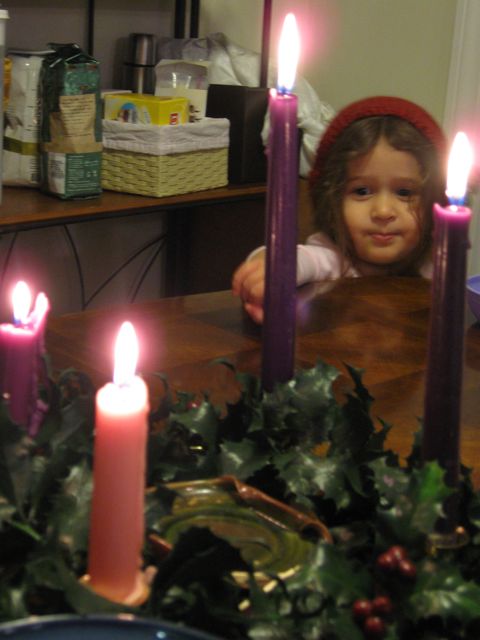
A simple, traditional devotion to aid your family’s liturgical focus is the Advent wreath. Place the blessed wreath at the center of your dinner table. After the family has gathered for the meal, turn off ALL the lights. Before the meal blessing, light the candles, one each for that particular week of Advent. The lighting should be accompanied by prayers, Advent hymns, or readings (made more challenging by the dark, of course), customized by your family’s preferences.

From our faith, we know that we live in a world of darkness and Christ is our only light [Jn 1:3-5]. But our eyes adjust to the darkness, and we can fail to recognize our need for the Uncreated Light. This nightly devotion provides us a perspective on reality. The burning candles become for us, “…a symbol of the prophetic light gradually illuminating the long night prior to the rising of the Sun of justice.” [Directory on Popular Piety, 98]. The subdued light draws the family together and reminds them of Whom is at their center, and that they too are refugees until the day they behold the Eternal Light, gathered with their true family for a feast beyond imagination. After four weeks, even children will anticipate the Infant Jesus more than Santa Claus.

Whether He’s descending the clouds, placed in a manger, or lifted by the hands of a priest, you and your family will welcome the Divine Guest in your heart, and pray with grateful longing, “Come, Lord Jesus!”

For resources on this and other family Advent devotions, visit our Gift Center and view the Advent Workshop at www.catholicculture.org.

Tuesday, August 18, 2009

Catholic Culture


"And if the watchman see the sword coming, and sound not the trumpet: and the people look not to themselves, and the sword come, and cut off a soul from among them: he indeed is taken away in his iniquity, but I will require his blood at the hand of the watchman. 7 So thou, O son of man, I have made thee a watchman to the house of Israel: therefore thou shalt hear the word from my mouth, and shalt tell it them from me." (Ez 33:6-7)

I'd like to take this opportunity to put a plug in for a website that keeps delivering time and time again. For years, my homepage was CatholicCulture.org. It was a website that served as a clearinghouse for useful Catholic information, dealing in both current and timeless issues. Right as the page opened, we would see where we were on the liturgical calender, see the Collect from the mass, find headlines on news related to the Church, read solidly Catholic commentary, and have easy access to devotions, crafts, and recipes for the Domestic Church. They have an impressive library of documents and public domain publications to research just about anything Catholic.

This website has undergone some changes over the years, most particularly a merger with their then sister website, the Catholic World News. Some of the information takes some searching these days, but all the stuff is still there.

My homepage was changed recently to the Blogger Dashboard so that I can follow the better bloggers out there. But we are still a monthly financial contributor and visit their website often. I cannot recommend a better website out there for daily immersion in your Catholic faith.

Their main contributors, Dr. Jeff Mirus and Phil Lawler, speak their minds. They are very respectful and humble, yet they have to courage to offer their opinions on controversial matters, even as their enterprise depends on donations from readers and faithful dealings with the Bishops. A quick search of their documents shows that they take a skeptical view of Medjugorje, something certain to alienate a large portion of potential readers. They also won't shy away from reporting unflattering information that may hurt fundraising efforts of the USCCB's pet projects. If there is an alarm that needs to be raised, they will do their duty.

So please visit them often, and contribute if you like what you see. I'm sure in these current economic times, they could use the boost. Also, keep an eye on their blog. Just this morning, Lawler is offering a couple of interesting contributions of interest to all Catholics.

For instance, recall my post on education that had some unflattering characterizations of the current Health Care Reform debate. But with a Culture of Death administration and a Culture of Death congress pushing health care reform, why have the Bishops for the most part remained on the sidelines? Mr. Lawler writes respectfully of the second Catholic contingent in this debate:
"This difference in perspectives, I think, is at the heart of the recent debate among Catholics over questions such as whether or not Catholic Charities should support health-care reform legislation. Some Catholics-- let's put the folks from Catholic Charities in this category-- have been working hard to enact health-care reform. Now the time is ripe, there's plenty of momentum behind the effort, and they're frustrated to see that the abortion issue is jeopardizing all the progress. That's understandable."
Also offered this morning is an important issue to ALWAYS keep in the forefront of our daily lives. Lawler reminds us of the persecution of the Church in India, a nation in which the United States has taken a growing economic interest(my emphasis in bold):

"Over the years we have carried literally hundreds of stories about the sufferings of Christians in India-- as well as the trials that our Christians brethren face in other countries. (See today's Feature about the latest fervent pleas by Vietnamese Catholics for an end to government oppression.) But I'm sorry to say that these stories attract fewer readers than most other CWN headlines. That's a shame-- literally-- because Alex Kannattumadom is right. Wherever Christians are suffering for the faith, they deserve our support.

Maybe there isn't much that we can do to help our fellow Catholics living thousands of miles away, apart from praying for them. But prayer is the most important step that we could take to preserve their hope and their courage. And the knowledge that we are praying for them should bolster their morale."

By all means, pay close attention to what's going on at Catholic Culture. I can attest that these guys will keep you better informed Catholics.


Saturday, July 11, 2009

She didn't just say that...


You've got to be kidding me. Either I'm completely out of touch or this person is. I scanned the headlines and found the most bizarre headline:

Without a Doubt:

Why Barack Obama represents American Catholics better than the pope does.

What? Oh, let me guess. As Americans, we're smarter than the rest of the Church. We know Jesus better than those old guys at the Vatican. We've advanced further and discovered things they have yet to tap into. We've inherited some sort of nuanced enlightenment by virtue of our geography.

Might this article contain something other than the tired-old sound bytes about reducing (not ending) abortions and helping the poor by creating secular government bureaucracies to distribute our love?

Nope. But this article is still a great read, because it goes beyond the sound byte and provides the depth (or shallowness?) of this person's lack of ascent. Finally, someone from the liberal church has the guts to explain herself completely and expose the arrogance, egotism, and complete disregard for the virtue of obedience.

The entire article is an outrage. I'll quote this one snippet:


"Before he became John Paul II, Karol Wojtyla had a telling all-or-nothing formulation: "If it should be decided that contraception is not an evil in itself then we should have to concede frankly that the Holy Spirit is on the side of the Protestant Churches."

That attitude has resulted in some heinous decisions."

Oh, I see. The entire magisterial teaching on the use of contraception can be reduced to our Church leaders not wanting to admit a mistake. This, from a person claiming earlier in the article that...

"... listening to the other has been a particular stumbling block for the Catholic hierarchy"

Hipocracy, thy name is Kathleen Kennedy Townsend. If you had bothered to actually read Humanae Vitae, and the teaching of His Late Holiness John Paul II, you would not detract from these beautiful and divinely inspired teachings by reducing them to the sin of pride, which unfortunately is something that you understand quite personally and to which you can obviously relate (judging alone from this article, this conclusion is unmistakable).

Let me explain. We are Catholic Americans. Yes, we have our own culture that we value. We do things differently and have our own attitude, and a unique identity. But the "Catholic" comes first. We are not American Catholics. Were we to be American Catholics, we would cease to be catholic. By it's very name, "Catholic" transcends lesser characteristics of our person. Were these lesser characteristics to be greater, we would cease being catholic. What made the Catholic Church catholic was when there became no distinction between Jew or Gentile, Hebrew, Samaritan, or Greek. We are a family of faith that works in the USA, England, Lebanon, India, China, Australia, and Ghana. All of us connected by one God, one faith, one baptism. The second we start believing in ourselves above the mystical body of Christ, we become heretics, separated brethren. We become Martin Luther, Henry VIII, or Bishop Marcel Lefevre. Our Lord said, "You be one, or you be not mine."

This person needs so many prayers. Please pray for her. And she's not alone. Our parishes have many just like her. It is a fundamental hang-up that I suffered from most of my life. It really is, in my opinion, and denial of the divine. We want to believe in our own infallibility, or at least our own ultimate authority in our lives. We look at the Church as a man-made, fallible institution, not is the mystical body and bride of Christ. And we can't look beyond our own prism, which is this case is one in which all matters can be reduced to politics. When I was there, many good Catholics prayed for me. I have so far to go, I know, but at least I'm not THERE any more, thanks to God's grace and prayerful Catholics.

He is infinite. He can bring the coldest hearts and the stiffest necks back home. The mindset of the liberal church is insurmountable through reason. But it's nothing for God. I will be turning my offense into prayer. If He is just waiting for us to ask, let Him wait no longer.

Monday, May 18, 2009

The Fighting Relativists of ND - Post Script

I'm not really feeling inspired enough to produce a blog post. However, I am motivated to bury the post directly below this one. Despite Andy's well intentioned point, posting videos of such a grotesque nature might be offensive to certain classes of people, for instance, people who breathe.

So, on to Notre Dame. I must confess that as one who was an avid college football fan before becoming an avid Catholic, I have had little regard for the University of Notre Dame, the prima donna of the college football community. Too good to join an athletic conference. Too fawned-over to actually have to have a decent team in order to be ranked. So worshiped by the sports media that they get opportunities not afforded to other teams (like getting a shot an #1 Florida in in the 1992 Sugar Bowl).

Now things are different, and, unfortunately, my attitude hasn't changed much. I'm not at all thrilled that they have a mural of the Risen Lord that they trivialize by calling it "Touchdown Jesus". And they employ on their Theology staff a Fr. McBrien, who's never found a doctrinal error that he didn't want to teach.

In short, Notre Dame did not impress the secularistic or the theistic portions of my life. But three years ago, something happened that made me reconsider. Father Jenkins, the university president, voiced a marvelous critique of Vagina Monologues, and seemed to be signally an eventual ban from the Notre Dame campus. Progress, so I thought, initiated by a courageous priest willing to stand-up for Catholicism in the midst of the antithetical world of American academia. That lasted a few weeks before he folded like the football team did against Oregon State in the Fiesta Bowl (or the Insight.Com Bowl, take your pick). Any thoughts of sending my kids there lasted for the same few weeks.

So as far as Obama's honorary degree and his commencement speech go, I have to say that I'm encouraged by the fact that some Catholics put up a fights. Over 70 bishops penned their disapproval! When have we ever seen that? And while the mainstream media avoided the condemnations and protests, noting them only to display them as freakish, the news that Notre Dame won't honor a basic moral principle is out, and they will be damaged goods to faithful Catholics until they clean house.

Father Z followed the story tenaciously, and he seems a little discouraged by the outcome. But still looking forward, he offers a solution to this and other deeply rooted problems within the Catholic community.
We are not getting the fullness of the Church’s teachings from Notre Dame or other, now lesser, water carriers of the secularist agenda. We are not getting it from very many of our leaders in the Church.

And so…

I urge all priests and bishops who read this blog with any slight quaver of resonance or benevolence, to consider this with care:

If you sense that something quite serious and important is going on right now, for the love of God rethink your approach to how you foster Holy Church’s proper public worship.

Do all in your power and through your influence to foster a worship of God which conforms not to worldly goals – as praiseworthy as they may be in a world still dominated by its dire prince – but rather to the real point of religion: an encounter with mystery.

Our worship must become more and more focused on the one who is Other. Seek what is truly above in your rites and raise people to encounter mystery.

You will be challenged and reviled, blocked and attacked as you do. You will be worn down and afraid under the weight of resistance.

But I think that to save the world we must save the liturgy.

Sunday reaffirmed this for me.

They can’t compete with the fullness of Catholic liturgy and sound preaching.

Reforming the liturgy along the lines Pope Benedict has proposed may be the most loving and effective option we have in these ever hotter times.

People will have to keep working very much in the sphere of the secular. Of course! Our inward Catholic Christian identity must find outward expression and bring concrete fruits.

But I think the real work now – where we will make some effective headway – must be done at the level of our public worship.
It always keeps coming back to that.


Tuesday, May 12, 2009

Idle Hands


And the book of Isaias the prophet was delivered unto him. And as he unfolded the book, he found the place where it was written: The Spirit of the Lord is upon me. Wherefore he hath anointed me to preach the gospel to the poor, he hath sent me to heal the contrite of heart, to preach deliverance to the captives, and sight to the blind, to set at liberty them that are bruised, to preach the acceptable year of the Lord, and the day of reward. And when he had folded the book, he restored it to the minister, and sat down. And the eyes of all in the synagogue were fixed on him. – Luke 4:17-20

In the above scripture, our Blessed Lord put two scriptures together from Isaiah for his listeners in the Nazarene synagogue.  I’m going to try something remotely similar by putting together two recent blog posts.  WARNING – Do not try this at home.  Only a true mytagogue is qualified for such advanced techniques.

Recently, Adoro provided a witness to the problem with the accepted view of evangelizing the new generation of young adults. 

  [T]hey (we!)  are seeking God. And if they enter a parish and find the theology of the parish to be wishy-washy, they leave. If they find disunity, they leave. If they find outreach without sincerity and REAL understanding...they walk.  They realize their lives are worth far more than a ten-cent smile and a frivolous handshake.  They don't want their singlehood to become one of slave labor to the Church, their singlehood a memory of years spent in weird pigeonholed isolation at a parish that doesn't know what to do with them other than to plug them into various volunteer holes that need warm bodies to fill them.   

Young adults want to get involved, yes. Absolutely. But not without a deeper meaning. Not without God. For their primary search, even if they can't explain it, is God. They are seeking happiness. They are seeking Our Lord, and they don't know where YOU have placed Him.

How true!  All too often, as we look to build our parish communities, we end up chasing a somewhat secular (faithless) model for building an organization.  We can’t reach them unless we get them through the door.  We can’t keep them unless they return.  They won’t return unless our community appeals to them.  They won’t be committed unless we give them something to do.  If we push through all of that, the sacraments will do their thing and our community will become the workers’ paradise that we keep singing about.

While I am knocking this approach, it would be wrong not to admit that there is some secular logic to it, which makes it thoroughly tempting.  The flaws, though, are fatal.  I’m sure its practitioners who pervade today’s Catholic parishes are absolutely sincere in their intention of doing the Lord’s work.  But, to put it bluntly, they are following the ideology of Nimrod, that infamous architect of the Tower of Babel .  They left the Catholic Church, the Bride of Christ, behind.  They deliberately ignore Rome, believing that the Holy Spirit can guide us to come up with something better than what God gave us through the Catholic Church.

There are legends that this self-made community works.  There may even be some real-world examples of it.  Yet everywhere I’ve seen it tried, the results are the same.  Efforts to get people more involved inevitably lead to burdening the people who are already too involved.  The stagnant population of the community tend to remain that way.

The bottom line – parishes are putting STEWARDSHIP ahead of CONVERSION.  In fact, there exists a general assumption that stewardship leads to conversion.  It is self-evident that this is entirely backwards.  Did Mother Teresa become a saint because she fed the hungry and cared for the dying?  Or did she feed the hungry and care for the dying because she became a saint?  According to her, and human reason, it’s the latter.

What keeps us Catholics from getting this right?  It’s pretty simple.  If a parish is addressing the needs of souls, it’s doing what it’s supposed to do.  A people that is deeply in love with our Lord Jesus will build the Kingdom the way He wants it built, and that’s all that matters.  Sorry, Nimrod.

And what can a parish do to accomplish this?  For starters, let everyone drop his or her pride, pastors and lay leaders alike.  Read the exhortations of the pope, the dogmatic documents of the ecumenical councils, and the instructions from the curia.  Then watch our Holy Father in action.  How does he say mass?  What is he focusing on in his addresses?  Then look at your community.  Where is your parish lagging?  What is your parish disregarding?  (hint: if the Bishop allows it, it doesn’t mean it’s good.  If he demands it, well, that’s another matter.)  Then get to work on preparing the parish to receive the sacraments in the manor set forth by our High Priest, through his Bride.  The deviation from the treasures God has given us through the Church is an exercise in pride.  Souls will suffer, despite the pleasant veneer some will claim.  

As our Holy Father wrote in a previous job (my emphasis):

[The obligatory character of the liturgy] is a guarantee, testifying to the fact that something greater is taking place here than can be brought about by any individual community or group of people. It expresses the gift of joy, the gift of participation in the cosmic drama of Christ's Resurrection, by which liturgy stands or falls. Moreover the obligatory character of the essential parts of the liturgy also guarantees the true freedom of the faithful: it makes sure that they are not victims of something fabricated by an individual or a group, that they are sharing in the same liturgy that binds the priest, the bishop and the pope. In the liturgy, we are all given the freedom to appropriate, in our own personal way, the mystery which addresses us.Feast of Faith, p 67

Fidelity to the liturgy, along with the needed catechesis (see the blog’s masthead for details), will properly dispose the faithful to the sacraments they receive.  This will light the fire that most seem to think will come about through happy songs and passing out sacred vessels.

And, speaking of happy songs, let me get back to the promise of joining together two blog posts.  Music is a major problem with liturgy today.  Parishes actively seek what they consider attractive music to please the people in the worship space nave.  This form of superficial evangelization plays right in to the misguided attempt to lure young people that Adoro blogged about.  True to form, this attempt to occupy minds and hearts during “silent” periods not only misses the point, but counters the point in so many ways.  Jeffry Tucker wrote a manifesto of sorts on the sociology of Church music, and in doing so covers why this attempt to entertain the people fails miserably:

In light of this, special demands are placed on Catholic musicians to use music that embraces what unites us and allows Catholic communities to thrive, understanding that anyone who is choosing their religion by social considerations alone is not likely to be interested in the Catholic faith to begin with. If we attempt to jump into the existing rivalrous market of demographic stop-'n'-shop, we are surely going to lose. There is always a body of believers out there who can do this better than we can.

And there is another factor here to consider. To seek to appeal to a certain group, we necessarily alienate other groups. We've all had the experience of car pooling or riding in the car with someone who has the radio tuned to a station we find egregious. So it is when we choose this over that form of secular music for our worship. We cannot and will not agree so long as we are choosing on subjective grounds alone.


This is the great error made variously in the history of the faith, mostly recently in the 1960s and 1970s in the U.S. when Catholics attempted to tailor-make their liturgy to blend in with a slice of time in order to win the hearts of a certain age demographic that temporarily believed its wishes were more important than anything else. To do this ended up creating massive division, and we still face the consequences today.

What do Catholics have as a primary concern that others put lower down the list? It is that most unfashionable idea of universal truth, a body of belief and practice, that transcends politics, community, nation, and even time. That is something so precious and wonderful, so appealing in the long run, that we should never turn away from it but rather embrace it completely. In that same way, sacred music challenges us to leave aside our tastes, to bury our egos, to turn off our iPods and digital subscriptions, to look outside our own group identity, and sing a new sing unto the Lord (the text to the Introit in the 5th Sunday of Easter).
I have found myself more and more attracted to a mass that appreciates sacred music.  What a difference from the busyness of the typical performance-style music provided today at most parishes!  I’ve spent many hours in front of the Blessed Sacrament simply making up for the prayer I missed at mass because the entertainment was so distracting.  As efficacious as it is to be in eucharistic adoration, it is no substitute for the mass, where offerings are always accepted and multiplied.  There’s a noise compulsion that is clearly at odds with the mass, as if active participation means we need to keep people’s attention occupied for fear they might have a prayer encounter of their own.

Recently, while commuting home, I heard a Protestant service on the radio.  It was very evangelical, with a charismatic preacher imploring his flock to spread the gospel.   That was followed by a cover of a praise and worship song (guitar, bass, drums, a lot of “I will do this” and “I will do that”) I’d heard before at mass.  But there was a huge difference when I heard it this time.  The music was a perfect fit!  It belonged in this direct style of worship.  There was no mystery to contemplate.  There was no awe in the Incarnation, Death, and Resurrection of our Lord.  It was simple, it was emotional, and it was motivating.  And with the adrenaline rising through the body, the music was seamless.  Thus, praise and worship music has a place.  That was an epiphany for me.

And what purpose does it serve at the mass?  For that matter, what do the emasculated show tunes, jingles, and hippy songs in our modern “song” books accomplish?  At best, they relieve us as we endure the boredom of our weekly liturgy.  At worst, they dull the encounter with our Lord.  They rob us of the, “… freedom to appropriate, in our own personal way, the mystery which addresses us.”  They create noise which deflects our minds and hearts from the fullness of meeting the one whose death makes eternal happiness possible.

It basically changes the mass into a sing-a-long communion service.  As one wise blogger put it, it’s like preparing a prime rib eye steak with a blender.

The result?  Deep conversion is much more difficult as people miss the opportunity to have the fullness of grace which was offered to them.  This is no small matter.  This is a self-inflicted cap on spiritual growth, not to mention a source of theological confusion.

To sum up this entire post, busyness is not the answer to call of the New Evangelization.  Jesus is the answer.  That hasn’t changed in 2000 years.  If someone thinks he has a better idea than the Catholic Church, you know, the one guided by the Holy Spirit, then that someone has his own need of a deeper conversion.  We can’t offer anyone, young or old, something that we don’t have.  Yes, we do have sacraments.  But our vanity can, and does, diminish the work of those sacraments on our lives.  When we truly make the effort to surrender ourselves to His authority and assist at mass to our fullest capacity, no ministry scheme and no liturgical customizations would compare to the attraction we would possess. 

Just to be clear, I am all in favor of innovation and ideas.  But they must first be checked against the directions and advice of Church authority.  All Catholics of good faith want the same thing.  We just need to remember, Nimrod isn’t going to get us there.

Thursday, April 23, 2009

Go Fish

The "Spirit of Vatican II" (or SVII for short[see update below]) takes a blow in the diocese of Steubenville. The American Papist has details:

Okay, technically, Catholics in the US are only allowed to dispense from the year-round Friday abstinence from meat if they substitute a comparable penance for it ... but in practice, the vast majority of Catholics have forgotten to even do this. Bishop R. Daniel Conlon, however, has dispensed with the substituting ... and has instead brought back the simple Friday abstinence from meat in his diocese. I especially respect that he ties this sacrificial abstinence to witnessing for the unborn and providing them with concrete assistance:

"I am inviting the Catholic people of the Diocese of Steubenville to resume the practice of abstaining from meat on all Fridays throughout the year, but with a twist. I am asking that this be not only a penitential practice but also an experience of prayer and service. This can happen by connecting abstinence with our witness to the sacredness of human life. (In another section he says: Abstinence can also be service if we eat simple meatless food and donate the financial savings to the poor or to pro-life efforts.)"

I've heard detractors of Friday abstinence say that it's not that much of a sacrifice. In fact, this is true. But neither is saying three Hail Mary's after confession. It doesn't have to inflict pain in order to be a sacrifice. Man cannot make a sacrifice of his own worthy of our Creator. God takes small sacrifices, like plain bread and wine, and gives us Himself in return. What's good about Friday abstinence is it reminds us that we're Catholic. It's a devotion that causes one to make different choices, to plan in advance, and to have to mortify one's appetite from time to time. One does not disrupted something as routine as eating without recalling why, and it becomes an offering, small as it may be. Additionally, it reminds others that we're Catholic. Just today, I had a person at work count me out of pizza for tomorrow for this reason. He informed me that Lent was over despite being certain that I already knew that.

I know the dispensing of Friday abstinence had little to do with Vatican II, at least officially. But this is clearly one of the fruits of that SVII. Most of those fruits seem to be directed toward the shedding of our Catholic identity, be it liturgy, music, prayer, devotions, vocations, theology, or attitude. And like all the other dominoes that fell, it leaves those of us who grew up in the post-conciliar years scratching our heads. After all, they didn’t really dispense with Friday abstinence. They allowed it's dispensing only in the case of a willful substitution of penance. But no one knows that! Well, some people know that, but if you will allow me to generalize, this amendment to Friday abstinence was universally misunderstood. I guess my annoyance at liturgical abuses is misplaced when we can’t even get a simple precept of the Church correct. How could the shepherds of the Church allow this ignorance among the faithful?

Well, maybe they had other fish to fry.

Good for the Diocese of Steubenville! I pray that the faithful get behind this. If they do, other episcopates may follow Bishop Conlon's lead.

UPDATE - For clarification purposes, I'm not an advocate for ignoring Vatican II.  Quite the opposite.  So I am clear - Vatican II was guided by the Holy Spirit.  The term "Spirit of Vatican II" is what is coined by liberals to do and to advocate anything they want.  It is a spirit of infidelity, and has nothing to do with the Holy Spirit. 

Thursday, April 16, 2009

Soul Train


“Where there is no knowledge of the soul, there is no good: and he that is hasty with his feet shall stumble.” Proverbs 19:2

As your proto-typical lay mystagogue, I often spend a good twenty-to-thirty seconds pondering the deep mysteries of the faith.  One that has gripped me the last several weeks is my soul.  My soul, which is supposed to magnify the infinite God.  My soul, all of which is supposed to love God.  My soul, which said, “The Lord is my portion.  Therefore I will wait for Him.”  So much that we do as Christian faithful is for the soul, this thing that makes us living, immortal, and in the image of God.  Yet, I don’t know my soul.  I know my big hammer-toe, the odd dimple in my forehead, and my compulsion to eat cold hotdogs with ketchup right before retiring to sleep.  My soul, I must confess, I know only what I’ve been told, and that, unfortunately, hasn’t been much.

Knowing what’s good for the soul yet not recognizing the soul itself is where I find myself.  If only this wonderful gift from God would show up in some way.  Maybe then I could work harder for it.  Then I could see the damage I do when I sin.  Maybe then I could see the good that I do when I fast.  As a sinful, self-centered guy, I crave confirmations.  I want to be holy, just so long as it doesn’t get in the way of my own pleasure.  But maybe if I could see my soul in the mirror, or feel my soul in the nerves, or in some other way sense the soul, I could sacrifice.  I could measure progress with my senses, then I could recognize the benefit for myself and thus have a strengthened will to do what is right.

Now I know what you’re thinking after reading this (all three of you who read the blog) – “You’d be a whole lot better off if you started thinking about something other than yourself.  Like, maybe, hmmm, I don’t know…  God?”  And you are absolutely right to think that.  That is my problem.  That’s the core of my problem.  And I’m really good for those 20-30 seconds thinking about other people; my family, my friends, suffering children, things like that.  But it always seems to come back to me eventually.  I have trouble concentrating, which is why my blog posts tend to ramble. 

Now, back to the soul.  As the proverb says, where there is no knowledge of the soul, there is no good.  To state the obvious, that’s not good.  So what’s my problem?  Why can’t I connect to this spiritual gift that is an integral component of me?  Tonight I was out watching the kids as the sun was setting, reading a few pages from Pope Benedict’s book, written under the pseudonym Joseph Cardinal Ratzinger, The Feast of Faith.  He gives me a clue to this problem.  Actually, he strips me naked:

Psychologists tell us that our rational, everyday consciousness is only the surface of what makes up the totality of our soul. But we are so hounded by this surface awareness that what lies in the depths can no longer find expression. Ultimately man becomes sick for sheer lack of authenticity; he no longer lives as a subject: he exists as the plaything of chance and superficiality.  This is connected with our relationship to time. Our relationship to time is marked by forgetting. We live for the moment. We actually want to forget, for we do not want to face old age and death.  But in reality this desire for oblivion is a lie: suddenly it changes into the aggressive demand for the future, as a way of destroying time.  However, this romanticism of the future, this refusal to submit to time, is also a lie, a lie which destroys both man and the world.  The only way to master time, in fact, is the way of forgiveness and thankfulness whereby we receive time as a gift and, in a spirit of gratitude, transform it.

All three of you reading this blog – please pray for me that I might find my soul.  I’d like to find it before the day comes that my soul is all I have.  I think the more I know my soul, the more pleasant that day will be.

Happy Birthday Papa.  You are truly God’s gift to the Church in our age. 

Bless the Lord, all his works: in every place of his dominion, O my soul, bless thou the Lord.  Psalm 103:22

Monday, April 6, 2009

The Catholic Mass: The Love of Jesus for You

In the body of Christ today, especially in those who are separated from the Church (Protestants), I hear a lot of negativity surrounding the use of the word "religion". They like to emphasize "relationship" in contrast with "religion". They say things like, "Jesus did not come to give us religion; He came to give us a relationship."

But this is a fallacy. Jesus came to give us both a religion and a relationship.  Part of it stems from the fact that the Protestant faith isn't a religion at all - they are separated from the true religion. Protestant denominations seem to implement a set of rules because a set of rules is what they believe religion is supposed to be: thou shalt not drink wine, thou shalt not dance, thou shalt not do this, that or the other thing that their denomination 'says' is wrong.

In truth, many Catholics see our faith in much the same way: a bunch of rules and restrictions. Why does the Catholic Church force me to go to church on Sunday? Why do they force me to go to confession when I am in mortal sin before I receive the Eucharist? Why does the Catholic Church force me to confess my sins to a priest "rather than" just confessing them to God himself?  The "questions" are actually statements; the asker doesn't really want to know the answer to them. Rather they are a means for them to vent discontent toward a religion that they feel "bound" to practice.

I understand this sentiment. If we look at religion as a set of restrictions, then religion appears to "put a damper on our life". We play-act faith by going to mass, going through the ritual, but not letting anything really penetrate our lives.

But that is not what Jesus intended when he founded the Catholic Church. What Jesus intended for us was to experience the mystical reality of him through the physical world that we can experience - through the seven sacraments and the body of Christ, which is the Church, starting at the visible head on Earth (the Pope) and within all consecrated and lay people.

Each of the sacraments that Jesus gave to us are an expression of his love for us. We experience his love when we are renewed and justified at baptism, as we feel the water poured over us. We experience him physically in the Eucharist and the liturgy of the mass, when we ponder and remember the redeeming sacrifice he made for us, how he gave himself up for us and our sins - and we taste his very flesh. We experience continuing renewal through the sacrament of penance (or confession) as we experience the forgiving action and hear the words from the priest - they let us know in a very real way that our sins are forgiven. In confirmation we are sealed with the holy spirit with oil, a feel and a smell. Similar with the annointing of the sick, we hear the prayers, are annointed with oil and taste viaticum, food for the journey to heaven. Consecrated persons experience what must be a profound laying on of hands that imputes an indelible mark upon their soul, and their marriage to the Lord starts not when they reach heaven but on that very day of consecration/ordination.

In that same way, the liturgy is full of signs of Jesus' love for us, but yet so few of us know the spiritual realities that are happening in the mass because they take place in the invisible spiritual realm.  So the liturgy is designed to make those realities known to us.  One can really learn to understand God's love for us by becoming knowledgeable about the liturgy and what is behind the rubrics of the mass.  

That is what we hope to give to you in this blog - a respect for the dignity and beauty of the Catholic mass, a realization of just how important it is to have good liturgy, and a deep understanding of the fullness of truth in the Catholic faith.  

The mass is the perfect prayer, an eternal offering of thanks for the love that he has given us.  Let us rejoice to have been given such a gift, and return the love that Jesus has shown with our whole selves, and live the true faith!
"Jesus also suffered outside the gate, to consecrate the people by his own blood.  Let us then go to him outside the camp, bearing the reproach that he bore. For here we have no lasting city, but we seek the one that is to come. Through him [then] let us continually offer God a sacrifice of praise, that is, the fruit of lips that confess his name." - Hebrews 13:12-15