“The Church's great liturgical tradition teaches us that fruitful participation in the liturgy requires that one be personally conformed to the mystery being celebrated… Otherwise, however carefully planned and executed our liturgies may be, they would risk falling into a certain ritualism. Hence the need to provide an education in eucharistic faith capable of enabling the faithful to live personally what they celebrate.” (Pope Benedict XVI, SACRAMENTUM CARITATIS, 64)
Showing posts with label liturgy. Show all posts

Monday, December 28, 2009

REJOICE!


Thus saith the Lord: A voice was heard on high of lamentation, of mourning, and weeping, of Rachel weeping for her children, and refusing to be comforted for them, because they are not. Thus saith the Lord: Let thy voice cease from weeping, and thy eyes from tears: for there is a reward for thy work, saith the Lord: and they shall return out of the land of the enemy.
(Jer 31:15-16)


And all that sat in the council, looking on him, saw his face as if it had been the face of an angel.
(Acts 6:15)
Matthew points us to Jeremiah for a prophecy of the Holy Innocents. We needed the pointer, because most people would have thought that he was referring to the Assyrian slaughter of the Kingdom of Israel. That is where most of her children, and those of her maidservant, resided. Save the tiny tribe of Benjamin, the tribal family structure of all her children all but ceased. The surviving dominant tribe of Judah and the priestly tribe of Levi would better be described as the children of her older sister Leah.

But Matthew reminds us that the Word of God is not limited in meaning. The children of Bethlehem are hers, as this is the location of her tomb. Thus we can proceed to the words of comfort that dilute the sorrow of story. "Let thy voice cease from weeping, and thy eyes from tears: for there is a reward for thy work, saith the Lord: and they shall return out of the land of the enemy."

Two years ago today, my family was in our parish chapel for Mass. My son, Jack II, a joyful boy that would give Saint Stephen a run for his money in the most angelic face category, was just a tad over two years old. His language was at a stage where he knew very few words of his own, but could do a manageable job of parroting what he's heard. Even before his birth, we thought this boy would one day be a priest. This day of two years ago, he would provide yet another confirmation.

After communion, as the celebrant was finishing with the purification of the sacred vessels, the chapel was silent as can be. My son took advantage of the silence. He had quietly observed Mass from start to finish. He was too young to be bored. His older sister, Jackie I, was at that stage, and she was working her way through that boredom. Jack III wasn't yet a year old.

The priest made his way to the chair to be seated for a moment. At this particular parish chapel, the congregation universally remains kneeling until the closing prayer. As the priest sat down, Jack 2, for no reason we can figure out, shouted twice, "Re-joice!"

This brings to mind the words of Saint Paul from a little over two short weeks previous, "Rejoice in the Lord always! I say it again, rejoice." It's Christmas, of course. This day of Christmas, though, reminds us that the Lord is a sign of contradiction (Luke 2:34, Acts 28:22).

I am come to cast fire on the earth; and what will I, but that it be kindled? And I have a baptism wherewith I am to be baptized: and how am I straitened until it be accomplished? Think ye, that I am come to give peace on earth? I tell you, no; but separation. For there shall be from henceforth five in one house divided: three against two, and two against three. The father shall be divided against the son, and the son against his father, the mother against the daughter, and the daughter against the mother, the mother in law against her daughter in law, and the daughter in law against her mother in law. (Luke 12:49-53)

Since our first miscarriage, we've had a special connection to this Feast of the Holy Innocents. It's a sad connection, still in the back of our mind wondering what person was lost. Was it a boy or girl? What would he or she have looked like or been like? And try as I do, it is hard to understand why some die before baptism. I certainly have no claim to any merit for my baptism.

It's hard. Any family that's been through it knows that, though the grief is handled in different ways. Most friends of ours are certain that they have saints in Heaven interceding for them. We do pray to our departed children, now three in number. As far as their status, all I have to say is that I don't know and the Church doesn't know. The news is primarily good, though:

As regards children who have died without Baptism, the Church can only entrust them to the mercy of God, as she does in her funeral rites for them. Indeed, the great mercy of God who desires that all men should be saved, and Jesus' tenderness toward children which caused him to say: "Let the children come to me, do not hinder them,"allow us to hope that there is a way of salvation for children who have died without Baptism. (CCC, 1261)

I guess Limbo could be looked at as their worst possible fate, and that should be enough for my peace. Still, there is a pain that we carry. There is a desire that can't be fulfilled. And that's the way it will remain until the day that He fixes the mess that we make.

This day two years ago, we were just two to three weeks from laying to rest our second miscarriage. The death of innocents read in the liturgy was a reminder of the innocents that the Lord himself took, by his own accord, from our joy. Quite appropriately, we often are reminded on this day in the homily that abortion is our modern day equivalent of this biblical slaughter, only on a much higher scale.

But at least the abortionists can't see the face of the children!

How could Herod's thugs have slaughtered children in their mother's arms? This kind of depravity is unimaginable. Certainly not unprecedented - from Genghis Khan to Hitler to Saddam Hussein, we have plenty of examples to show that this kind of depravity is possible. But still beyond imagination.

Similarly, we celebrated the martyrdom of Saint Stephen just two days ago. They stoned him, even though they knew he was innocent. The Sanhedrin saw that he had the face of an angel, the face of innocence, and they still had him stoned.

How could they? How?

Early in Christmas, we commemorate two great acts of murder. It seems so distant from the tranquil adoration of the shepherds just a few days ago. Yet my son had it right. Rejoice! As one man with the blood of Stephen on his hands said, "Rejoice in the Lord always!" These days of Christmas should shock us out of our sentimental picture of an idealistic Nativity scene. The contradiction should not be blurred. If it is blurred, then we'll always be at the whim of apparent fortune.

We must trust in the Lord, as the man with Stephen's blood on his hands once said, "We know that all things work for good for those who love God, who are called according to his purpose." That means abortion, miscarriage, terrorism, despotism, genocide, starvation, etc., etc. Our challenge is to stay in the fight for good, but not be scandalized by the bad. Never get discouraged.

Sorrow is as certain as death and taxes. If rejoicing is a certain reaction for us as well, we'll be much further along. How many of us have looked into the face of Jesus and sinned? We have the blood of God on our hands, yet that same blood can cover our sins. How's that for a contradiction?

As we commemorate the death of innocents this Christmas, let us rejoice. Because to us was born the most innocent of the innocents, who will turn his own murder into our redemption. If the urge hits you, remind the somber that today is a day of Christmas - God came down to us -us in our depravity. No matter what happens, no act of evil will overcome that. Rejoice!

And when I am lifted up from the earth, I will draw everyone to myself. (John 12:32)

Thou must leave thy lowly dwelling,
The humble crib, the stable bare.
Babe, all mortal babes excelling,
Content our earthly lot to share.
Loving father, Loving mother,
Shelter thee with tender care!
Loving father, Loving mother,
Shelter thee with tender care!


Blessed Jesus, we implore thee
With humble love and holy fear.
In the land that lies before thee,
Forget not us who linger here!
May the shepherd's lowly calling,
Ever to thy heart be dear!
May the shepherd's lowly calling,
Ever to thy heart be dear!


Blest are ye beyond all measure,
Thou happy father, mother mild!
Guard ye well your heav'nly treasure,
The Prince of Peace, The Holy Child!
God go with you, God protect you,
Guide you safely through the wild!
God go with you, God protect you,
Guide you safely through the wild!


Thursday, December 24, 2009

God Among Us


Come Lord Jesus, do not delay; give new courage to your people who trust in your love. By your coming, raise us to the joy of your kingdom, where you live and reign with the Father and the Holy Spirit, one God, for ever and ever. Amen.
(Collect for Dec. 24th, Roman Missal)
Lo, the hand of the LORD is not too short to save, nor his ear too dull to hear. Rather, it is your crimes that separate you from your God, It is your sins that make him hide his face so that he will not hear you. For your hands are stained with blood, your fingers with guilt; Your lips speak falsehood, and your tongue utters deceit.

No one brings suit justly, no one pleads truthfully; They trust in emptiness and tell lies; they conceive mischief and bring forth malice. They hatch adders' eggs, and weave spiders' webs: Whoever eats their eggs will die, if one of them is pressed, it will hatch as a viper; Their webs cannot serve as clothing, nor can they cover themselves with their works. Their works are evil works, and deeds of violence come from their hands. Their feet run to evil, and they are quick to shed innocent blood; Their thoughts are destructive thoughts, plunder and ruin are on their highways. The way of peace they know not, and there is nothing that is right in their paths; Their ways they have made crooked, whoever treads them knows no peace.

That is why right is far from us and justice does not reach us. We look for light, and lo, darkness; for brightness, but we walk in gloom! Like blind men we grope along the wall, like people without eyes we feel our way. We stumble at midday as at dusk, in Stygian darkness, like the dead. We all growl like bears, like doves we moan without ceasing. We look for right, but it is not there; for salvation, and it is far from us. For our offenses before you are many, our sins bear witness against us. Yes, our offenses are present to us, and our crimes we know:

Transgressing, and denying the LORD, turning back from following our God, Threatening outrage, and apostasy, uttering words of falsehood the heart has conceived. Right is repelled, and justice stands far off; For truth stumbles in the public square, uprightness cannot enter. Honesty is lacking, and the man who turns from evil is despoiled. The LORD saw this, and was aggrieved that right did not exist.

He saw that there was no one, and was appalled that there was none to intervene; So his own arm brought about the victory, and his justice lent him its support. He put on justice as his breastplate, salvation, as the helmet on his head; He clothed himself with garments of vengeance, wrapped himself in a mantle of zeal. He repays his enemies their deserts, and requites his foes with wrath.

Those in the west shall fear the name of the LORD, and those in the east, his glory; For it shall come like a pent-up river which the breath of the LORD drives on. He shall come to Zion a redeemer to those of Jacob who turn from sin, says the LORD. This is the covenant with them which I myself have made, says the LORD: My spirit which is upon you and my words that I have put into your mouth Shall never leave your mouth, nor the mouths of your children Nor the mouths of your children's children from now on and forever, says the LORD.

Rise up in splendor! Your light has come, the glory of the Lord shines upon you. See, darkness covers the earth, and thick clouds cover the peoples; But upon you the LORD shines, and over you appears his glory. Nations shall walk by your light, and kings by your shining radiance.

Raise your eyes and look about; they all gather and come to you: Your sons come from afar, and your daughters in the arms of their nurses. Then you shall be radiant at what you see, your heart shall throb and overflow, For the riches of the sea shall be emptied out before you, the wealth of nations shall be brought to you. No longer shall violence be heard of in your land, or plunder and ruin within your boundaries. You shall call your walls "Salvation" and your gates "Praise." No longer shall the sun be your light by day, Nor the brightness of the moon shine upon you at night; The LORD shall be your light forever, your God shall be your glory. No longer shall your sun go down, or your moon withdraw, For the LORD will be your light forever, and the days of your mourning shall be at an end.

Your people shall all be just, they shall always possess the land, They, the bud of my planting, my handiwork to show my glory. The smallest shall become a thousand, the youngest, a mighty nation; I, the LORD, will swiftly accomplish these things when their time comes.

The book of the genealogy of Jesus Christ, the son of David, the son of Abraham.

(Abraham was) the son of Terah, the son of Nahor, the son of Serug, the son of Reu, the son of Peleg, the son of Eber, the son of Shelah, the son of Ca-inan, the son of Arphaxad, the son of Shem, the son of Noah, the son of Lamech, the son of Methuselah, the son of Enoch, the son of Jared, the son of Mahalale-el, the son of Ca-inan, the son of Enos, the son of Seth, the son of Adam, the son of God.

Abraham was the father of Isaac, and Isaac the father of Jacob, and Jacob the father of Judah and his brothers,

and Judah the father of Perez and Zerah by Tamar, and Perez the father of Hezron, and Hezron the father of Ram, and Ram the father of Amminadab, and Amminadab the father of Nahshon, and Nahshon the father of Salmon, and Salmon the father of Boaz by Rahab, and Boaz the father of Obed by Ruth, and Obed the father of Jesse,

and Jesse the father of David the king. And David was the father of Solomon by the wife of Uriah, and Solomon the father of Rehoboam, and Rehoboam the father of Abijah, and Abijah the father of Asa, and Asa the father of Jehoshaphat, and Jehoshaphat the father of Joram, and Joram the father of Uzziah, and Uzziah the father of Jotham, and Jotham the father of Ahaz, and Ahaz the father of Hezekiah, and Hezekiah the father of Manasseh, and Manasseh the father of Amos, and Amos the father of Josiah, and Josiah the father of Jechoniah and his brothers, at the time of the deportation to Babylon.

And after the deportation to Babylon: Jechoniah was the father of She-alti-el, and She-alti-el the father of Zerubbabel, and Zerubbabel the father of Abiud, and Abiud the father of Eliakim, and Eliakim the father of Azor, and Azor the father of Zadok, and Zadok the father of Achim, and Achim the father of Eliud, and Eliud the father of Eleazar, and Eleazar the father of Matthan, and Matthan the father of Jacob, and Jacob the father of Joseph the husband of Mary, of whom Jesus was born, who is called Christ.

So all the generations from Abraham to David were fourteen generations, and from David to the deportation to Babylon fourteen generations, and from the deportation to Babylon to the Christ fourteen generations. (Isaiah 59:1-21, 60:1-5, 18-22; Matt 1:1; Luke 3:34b-38; Matt 1:2-17)

Monday, December 21, 2009

Our Darkest Day

And he hath broken my teeth one by one, he hath fed me with ashes. And my soul is removed far off from peace, I have forgotten good things. And I said: My end and my hope is perished from the Lord. Remember my poverty, and transgression, the wormwood, and the gall. I will be mindful and remember, and my soul shall languish within me.

These things I shall think over in my heart, therefore will I hope. The mercies of the Lord that we are not consumed: because his commiserations have not failed. They are new every morning, great is thy faithfulness. The Lord is my portion, said my soul: therefore will I wait for him. (Lam 3:16-24)

Don't worry about the world coming to an end today. It's already tomorrow in Australia. (Charles Schultz)

This image of the Rising Dawn, Orient, Dayspring, or Sun of Justice (depending on the verse or translation), is one of the most used of the coming Christ. There seems to be something in our human programming that attracts us to this as it seems universal among various pagan religions. What images hope like the rising sun? It’s often used in analogies for certainty, as in, “As sure as the sun rises in the east…” And as this rising sun, an image of the our Lord’s Advent, Nativity, Resurrection, and Return, a hope we can believe in with certainty, comes up over the snow (the picture is the view from my doorstep), today in Vespers, we address our Savior as “Oriens”, the Rising Dawn.

I’m sure the ancient mystagogues figured this out years ago, but the dawn of this day is special, since it's our shortest day, making “Oriens” a fitting placement on the calendar.

This brings to mind an interesting documentary I saw last year, The Star of Bethlehem. It’s impressive. That’s assuming the self-produced film isn’t a hoax, and not being much of a star gazer myself I’m not in a place to pass judgment. The filmmaker and star, Frederick Larson, details his personal faith journey, his research and his amazing findings, showing what he believes is the real star. However, I was uncomfortable with part of what he stated.

According to the film, as I can recollect, he found these amazing messages in the stars around the time of Jesus’ birth that seem to correlate with the biblical account. However, Christian Tradition was ignored, and without a good reason in my opinion.

According to his figuring, the magi arrived somewhere around December 25th. I assume he’s using the Gregorian Calendar, but he didn’t specify. After showing these results, he goes on to say, “I’m not saying that Jesus was born on December 25th. I don’t think anyone believes that.” [My recollection of the quote]

Well, I hate to break it to him, but I do. His findings actually might suggest it if he would take another look at them and the biblical Nativity. I’m a year removed from watching it, so I can’t document it completely, but I don’t think he took into account two facts:

1. Zachariah was incensing the Holiest of Holies roughly six months before the annunciation. Such a ritual could only take place on one day in the year – Yom Kippur. This would have occurred between mid-September and mid-October, Gregorian (it would be interesting to see the actual dates of Yom Kippur from 2 and 3 BC). From a theological perspective, this makes perfect sense – to announce the forerunner, the one who will provide a baptism of repentance, on the Jewish Day of Atonement. This, quite conceivably, could have taken place on the Autumn Equinox. So, with some rough reckoning (Annunciation six months later, and our Lord’s Nativity nine months later) we can see, with the Bible as our guide, that Jesus must have been born sometime near December 25th.

2. Under the Julian calendar, June 24th was the Summer Solstice, and December 25th was the Winter Solstice. Of course, June 24th is the Nativity of John the Baptist, the one who said, “He must increase, and I must decrease.” And, on the old calendar, the sun in fact did decrease daily, until the darkest day of the year, December 25th. God could pick no better day than this one to bring to us the Light of the World, when the world was most in need of light.


The date of December 25th fits biblically and uses the natural rhythms of nature to tell us something theologically. Frederick Larson, for all his interesting work on the biblical star, missed that. I still highly recommend this video – it is extremely impressive despite my quibbles. But it’s too bad, because even if he doesn’t give the date of Christmas credence, his research still points to it. His findings also gives the magi longer than twelve days to arrive at Bethlehem, something they would definitely need if they in fact launched from Susa, Babylon, Nineveh, or some other place of Zoroastrian-Persian origin. An arrival on January 6th (Julian) certainly wouldn’t seem out of the question with his findings.

I guess the point is, Catholic Tradition is reliable, as sure as the sun rises in the east. In fact, more sure, because even the atheists know that the day will come when the day won’t come.

And although I will keep in line with the Church and celebrate Christmas on December 25th, it is still not lost on me that Jesus was born on the old December 25th, the Winter Solstice, which is in fact today. Happy Birthday, my Lord!

O Rising Sun, splendour of light eternal and sun of righteousness: Come and enlighten those who dwell in darkness and the shadow of death. (Vespers Antiphon, Divine Office for Dec 21)

Sunday, December 20, 2009

Light Number Four


Rise up in splendor! Your light has come, the glory of the Lord shines upon you. See, darkness covers the earth, and thick clouds cover the peoples; But upon you the LORD shines, and over you appears his glory. Nations shall walk by your light, and kings by your shining radiance. (Isaiah 60:1-2)

I was asked last year to write an article on the Advent Wreath for a parish newsletter. It was never published. But, here you go:


The Spirit and the bride say, "Come.” Let the hearer say, "Come.” [Rev 22:17a]

Please ask yourself, “Can I genuinely pray from the heart, ‘Amen! Come Lord Jesus!’ as John the Apostle did?” It can be difficult. For many of us, our lives are comfortable. We all have times of stress, anguish, and unhappiness, but most of us are not ready to trade the life we know for the tribulation of the Second Coming. Fear of this is understandable. But that fear can be replaced with “joyful hope” through the pious observance of Advent.

What would Easter be to us were it not preceded by the journey of Lent, walking with our Lord to the Cross? So too, Advent is the key to the preparation for and appreciation of the Incarnation, manifested by a birth in the poverty of refugee lodging. God the Son condescended to become man. Imitate Him during this much-neglected penitential season.

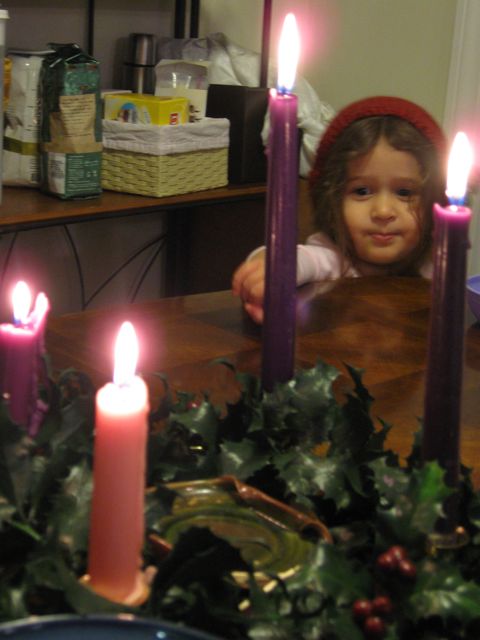
A simple, traditional devotion to aid your family’s liturgical focus is the Advent wreath. Place the blessed wreath at the center of your dinner table. After the family has gathered for the meal, turn off ALL the lights. Before the meal blessing, light the candles, one each for that particular week of Advent. The lighting should be accompanied by prayers, Advent hymns, or readings (made more challenging by the dark, of course), customized by your family’s preferences.

From our faith, we know that we live in a world of darkness and Christ is our only light [Jn 1:3-5]. But our eyes adjust to the darkness, and we can fail to recognize our need for the Uncreated Light. This nightly devotion provides us a perspective on reality. The burning candles become for us, “…a symbol of the prophetic light gradually illuminating the long night prior to the rising of the Sun of justice.” [Directory on Popular Piety, 98]. The subdued light draws the family together and reminds them of Whom is at their center, and that they too are refugees until the day they behold the Eternal Light, gathered with their true family for a feast beyond imagination. After four weeks, even children will anticipate the Infant Jesus more than Santa Claus.

Whether He’s descending the clouds, placed in a manger, or lifted by the hands of a priest, you and your family will welcome the Divine Guest in your heart, and pray with grateful longing, “Come, Lord Jesus!”

For resources on this and other family Advent devotions, visit our Gift Center and view the Advent Workshop at www.catholicculture.org.

Wednesday, November 11, 2009

How Terrible Is This Place!


Our family marks the liturgical calendar at our Grace Before Meals. Following the typical "Bless us, O Lord..." we add a little verse to remind us of the season or the liturgical day. We don't do that for every day, just for the Solemnities, Feasts, and special saints. The rest of the time, the verse is to remind us of the monthly devotion (e.g. the Holy Name in January) or the season (Advent, Easter, etc.)In the last year, I reformed the verses using the old Roman Missal (from the Introits, Graduals, Communios, Vespers, etc.). Even though we follow the new calendar, I just like the language and liturgical choices of the old Missal.

Just to give you a for example, here are some verses from Palm Sunday through Divine Mercy Sunday.

Passion Sunday Hosanna to the Son of David - Blessed is He that cometh in the Name of the Lord
Holy Week The zeal of Thy house hath consumed me - And the reproaches of them that reproach Thee, fell upon me
Holy Thursday A new commandment I give unto you - That you love one another as I have loved you
Good Friday It is consummated - And bowing His head, He gave up the ghost
Holy Saturday The Lord is my portion, said my soul - Therefore will I wait for him
Easter Sunday Christ our Pasch is sacrificed, Alleluia - Therefore let us feast, Alleluia
Easter Octave This is the day which the Lord hath made, Alleluia - Let us be glad and rejoice therein, Alleluia
DM Sunday After eight days, the doors being shut, Alleluia - Jesus stood in their midst and said: Peace be to you, Alleluia

And so it goes. No, we don't memorize them. We have our handy spreadsheets nearby to help. Eventually, the monthly or seasonally verse gets memorized, and we ignore the spreadsheet. That always leads to missing a day or two (sorry Simon and Jude!)

My favorite verse in the spreadsheet is the one for November 9th. This one goes, "How terrible is this place! - It is none other than the House of God". To be honest, the reason I like it is it makes me giggle. Yes, I find it funny because of the alternative, and more used, meaning of "terrible", and I can't help but glance at the messy kitchen from the meal just prepared.

The whole Introit goes as follows:

Terribilis est locus iste: hic domus Dei est, et porta caeli: et vocabitur aula Dei.

Ps. Quam dilecta tabernacula tua, Domine virtutum! concupiscit, et deficit anima mea in atria Domini.

How terrible is this place? this is no other but the house of God, and the gate of heaven; and it shall be called the house of God. (Genesis 28:17,22)

How lovely are thy tabernacles, O Lord of hosts! my soul longeth and fainteth for the courts of the Lord. (Ps. 83(84):2, 3)
Followed by the signature doxology, and repeat.

It is interesting that, at least in the mass text (I haven't checked the Divine Office) that first part, the part that makes me giggle, is no longer a part of the liturgy. I have to say, that's sad. It's not sad that I don't get to giggle at mass. After all, the New American translation, I believe, is "Awesome" instead of "Terrible". But it is a verse that reminds us of where we stand in the church. Should we need a reminder? I'm sure Mary never needed one. But the fact is that I forget vastly more than I remember. When Israel uttered those words of Genesis, he trembled in fear. Even though we might not, it is important to remember that we should.

I think one of the most impressive fruits of Vatican II is the three-year cycle for the Missal. In pre-conciliar years, there was only a one-year cycle, and each mass had only one scripture reading before the Gospel (either a Lesson or Epistle). Today, we get much more of the Bible at mass, and it's truly a blessing. But unfortunately, something always falls out. The Mass of the Dedication of Saint John Lateran, much like other Masses of old, used to be named from the first words of the Introit. It is almost as if this Mass has lost its identity. And as one looks through the old Missal, it's easy to see a lot more. One can see why we used to be a much more militant "Church Militant".

I am grateful that we still have the old mass out there. As our Sacred Liturgy continues to evolve as the years go by, I do believe the current retention of the old form will act as a stabilizer for the new form as it undergoes future changes. I don't know for sure, but I think the bishops and the laity were so anxious to cut the old form loose that they had no idea what they were tossing aside. Thus, we've seen some pretty crazy things since then, most notably in the liturgy. In the old form, the rubrics seem to be universally respected. I sure wish the same could be said for the new form.

Our English-speaking bishops are really making strides in the right direction, returning language to the liturgy which will lend itself towards greater respect, maybe even a little trembling now and then. I pray for a successful transition, with full ascent from priests and laity. I hope that will lead to other changes. Like priests turning their back on the people, unafraid that they will turn back again and see the pews empty. Like a Latin Credo, chanted. Like a glorious organ reverberating during the recession. Beautiful altars! Pews that face the same direction! And sit lower than the sanctuary! Pianos and guitars shoved into the closet! Parishioners who say, "Yes, Father, I'm on it!" instead of "Why don't we try this..." Cats and dogs, living together!

My apologies. I got carried away again.

I'm sure there will be trouble. While we as a Church should proceed with caution and charity, like Jacob, we need to remember whom to fear.

Monday, August 24, 2009

Quick Liturgical Post


Liturgy seems to be on the mind of everyone on the cat-blogs. It's on my mind, too, but I'm busy at the moment so I'll put my thoughts in later - thoughts stemming from a conversation I had over breakfast with my wife.

The quickest way to write a post is to have others do it for you.

If you are a malcontent, like most of us lay mystagogues, you've heard this one before, "Well, at least we CAN go to mass! There are people all over the world that can't go to Mass at all!" Adoro gives us her take on that. That argument reminds me of the use of Elizabeth Taylor's (or any celeb's) multiple divorces as an argument for why same-sex should be okay.

Ignatius Insight has a post on one of their publications, a new book entirely on the ad orientum: Turning Towards the Lord. That one will be worth a read, after I get to the stack of books ahead of it. But the post itself provides a lot of detail, and will, no doubt, leave you with no choice as to buy the book.

And were you ever curious as to the liturgical reform from a century ago? I wasn't all that interested until Shawn Tribe blogged about Don Lambert Beauduin's 1914 publication, La Piété de l'Eglise. Here's just a snippet...
D. Propaganda 2. Reawakening the old liturgical traditions in the home, that link domestic joys with the calendar of the Church, and using for this end especially the musical works composed for such purposes.
Ding ding ding! This is what I plan to write about later. As for now, please read what others have to say.


Monday, August 17, 2009

Liturgical Prefigurement of the Cross


One thing I always love is when a great mystagogue adds another piece to the puzzle - in this case, that puzzle that we'll keep mystagoging for eternity, the Paschal Mystery of our Blessed Lord. Father Schnippel added another great piece today, my emphasis in bold:

"As Israel became established as a nation, this sacrifice was moved from the home to the Temple, for in the Temple, the Sacrifice became more liturgical, with associated prayers and rituals. In fact, one such ritual is vitally important for our study of Jesus as the New Passover: after the lamb for each family was killed, two wooden rods were inserted to assist in the roasting: one along the spine, the other through the ribs, from shoulder to shoulder. Each of these lambs, by the thousands, would be carried out of the Temple and to the homes of the people in and around Jerusalem. ‘Crucified lambs’ were being offered for the people."
Whoa! There's a new one for me. Please read his entire post, Jesus, the New Passover.
"And I saw that the Lamb had opened one of the seven seals, and I heard one of the four living creatures, as it were the voice of thunder, saying: Come, and see." (Rev 6:1)

Monday, May 18, 2009

The Fighting Relativists of ND - Post Script

I'm not really feeling inspired enough to produce a blog post. However, I am motivated to bury the post directly below this one. Despite Andy's well intentioned point, posting videos of such a grotesque nature might be offensive to certain classes of people, for instance, people who breathe.

So, on to Notre Dame. I must confess that as one who was an avid college football fan before becoming an avid Catholic, I have had little regard for the University of Notre Dame, the prima donna of the college football community. Too good to join an athletic conference. Too fawned-over to actually have to have a decent team in order to be ranked. So worshiped by the sports media that they get opportunities not afforded to other teams (like getting a shot an #1 Florida in in the 1992 Sugar Bowl).

Now things are different, and, unfortunately, my attitude hasn't changed much. I'm not at all thrilled that they have a mural of the Risen Lord that they trivialize by calling it "Touchdown Jesus". And they employ on their Theology staff a Fr. McBrien, who's never found a doctrinal error that he didn't want to teach.

In short, Notre Dame did not impress the secularistic or the theistic portions of my life. But three years ago, something happened that made me reconsider. Father Jenkins, the university president, voiced a marvelous critique of Vagina Monologues, and seemed to be signally an eventual ban from the Notre Dame campus. Progress, so I thought, initiated by a courageous priest willing to stand-up for Catholicism in the midst of the antithetical world of American academia. That lasted a few weeks before he folded like the football team did against Oregon State in the Fiesta Bowl (or the Insight.Com Bowl, take your pick). Any thoughts of sending my kids there lasted for the same few weeks.

So as far as Obama's honorary degree and his commencement speech go, I have to say that I'm encouraged by the fact that some Catholics put up a fights. Over 70 bishops penned their disapproval! When have we ever seen that? And while the mainstream media avoided the condemnations and protests, noting them only to display them as freakish, the news that Notre Dame won't honor a basic moral principle is out, and they will be damaged goods to faithful Catholics until they clean house.

Father Z followed the story tenaciously, and he seems a little discouraged by the outcome. But still looking forward, he offers a solution to this and other deeply rooted problems within the Catholic community.
We are not getting the fullness of the Church’s teachings from Notre Dame or other, now lesser, water carriers of the secularist agenda. We are not getting it from very many of our leaders in the Church.

And so…

I urge all priests and bishops who read this blog with any slight quaver of resonance or benevolence, to consider this with care:

If you sense that something quite serious and important is going on right now, for the love of God rethink your approach to how you foster Holy Church’s proper public worship.

Do all in your power and through your influence to foster a worship of God which conforms not to worldly goals – as praiseworthy as they may be in a world still dominated by its dire prince – but rather to the real point of religion: an encounter with mystery.

Our worship must become more and more focused on the one who is Other. Seek what is truly above in your rites and raise people to encounter mystery.

You will be challenged and reviled, blocked and attacked as you do. You will be worn down and afraid under the weight of resistance.

But I think that to save the world we must save the liturgy.

Sunday reaffirmed this for me.

They can’t compete with the fullness of Catholic liturgy and sound preaching.

Reforming the liturgy along the lines Pope Benedict has proposed may be the most loving and effective option we have in these ever hotter times.

People will have to keep working very much in the sphere of the secular. Of course! Our inward Catholic Christian identity must find outward expression and bring concrete fruits.

But I think the real work now – where we will make some effective headway – must be done at the level of our public worship.
It always keeps coming back to that.


Tuesday, May 12, 2009

Idle Hands


And the book of Isaias the prophet was delivered unto him. And as he unfolded the book, he found the place where it was written: The Spirit of the Lord is upon me. Wherefore he hath anointed me to preach the gospel to the poor, he hath sent me to heal the contrite of heart, to preach deliverance to the captives, and sight to the blind, to set at liberty them that are bruised, to preach the acceptable year of the Lord, and the day of reward. And when he had folded the book, he restored it to the minister, and sat down. And the eyes of all in the synagogue were fixed on him. – Luke 4:17-20

In the above scripture, our Blessed Lord put two scriptures together from Isaiah for his listeners in the Nazarene synagogue.  I’m going to try something remotely similar by putting together two recent blog posts.  WARNING – Do not try this at home.  Only a true mytagogue is qualified for such advanced techniques.

Recently, Adoro provided a witness to the problem with the accepted view of evangelizing the new generation of young adults. 

  [T]hey (we!)  are seeking God. And if they enter a parish and find the theology of the parish to be wishy-washy, they leave. If they find disunity, they leave. If they find outreach without sincerity and REAL understanding...they walk.  They realize their lives are worth far more than a ten-cent smile and a frivolous handshake.  They don't want their singlehood to become one of slave labor to the Church, their singlehood a memory of years spent in weird pigeonholed isolation at a parish that doesn't know what to do with them other than to plug them into various volunteer holes that need warm bodies to fill them.   

Young adults want to get involved, yes. Absolutely. But not without a deeper meaning. Not without God. For their primary search, even if they can't explain it, is God. They are seeking happiness. They are seeking Our Lord, and they don't know where YOU have placed Him.

How true!  All too often, as we look to build our parish communities, we end up chasing a somewhat secular (faithless) model for building an organization.  We can’t reach them unless we get them through the door.  We can’t keep them unless they return.  They won’t return unless our community appeals to them.  They won’t be committed unless we give them something to do.  If we push through all of that, the sacraments will do their thing and our community will become the workers’ paradise that we keep singing about.

While I am knocking this approach, it would be wrong not to admit that there is some secular logic to it, which makes it thoroughly tempting.  The flaws, though, are fatal.  I’m sure its practitioners who pervade today’s Catholic parishes are absolutely sincere in their intention of doing the Lord’s work.  But, to put it bluntly, they are following the ideology of Nimrod, that infamous architect of the Tower of Babel .  They left the Catholic Church, the Bride of Christ, behind.  They deliberately ignore Rome, believing that the Holy Spirit can guide us to come up with something better than what God gave us through the Catholic Church.

There are legends that this self-made community works.  There may even be some real-world examples of it.  Yet everywhere I’ve seen it tried, the results are the same.  Efforts to get people more involved inevitably lead to burdening the people who are already too involved.  The stagnant population of the community tend to remain that way.

The bottom line – parishes are putting STEWARDSHIP ahead of CONVERSION.  In fact, there exists a general assumption that stewardship leads to conversion.  It is self-evident that this is entirely backwards.  Did Mother Teresa become a saint because she fed the hungry and cared for the dying?  Or did she feed the hungry and care for the dying because she became a saint?  According to her, and human reason, it’s the latter.

What keeps us Catholics from getting this right?  It’s pretty simple.  If a parish is addressing the needs of souls, it’s doing what it’s supposed to do.  A people that is deeply in love with our Lord Jesus will build the Kingdom the way He wants it built, and that’s all that matters.  Sorry, Nimrod.

And what can a parish do to accomplish this?  For starters, let everyone drop his or her pride, pastors and lay leaders alike.  Read the exhortations of the pope, the dogmatic documents of the ecumenical councils, and the instructions from the curia.  Then watch our Holy Father in action.  How does he say mass?  What is he focusing on in his addresses?  Then look at your community.  Where is your parish lagging?  What is your parish disregarding?  (hint: if the Bishop allows it, it doesn’t mean it’s good.  If he demands it, well, that’s another matter.)  Then get to work on preparing the parish to receive the sacraments in the manor set forth by our High Priest, through his Bride.  The deviation from the treasures God has given us through the Church is an exercise in pride.  Souls will suffer, despite the pleasant veneer some will claim.  

As our Holy Father wrote in a previous job (my emphasis):

[The obligatory character of the liturgy] is a guarantee, testifying to the fact that something greater is taking place here than can be brought about by any individual community or group of people. It expresses the gift of joy, the gift of participation in the cosmic drama of Christ's Resurrection, by which liturgy stands or falls. Moreover the obligatory character of the essential parts of the liturgy also guarantees the true freedom of the faithful: it makes sure that they are not victims of something fabricated by an individual or a group, that they are sharing in the same liturgy that binds the priest, the bishop and the pope. In the liturgy, we are all given the freedom to appropriate, in our own personal way, the mystery which addresses us.Feast of Faith, p 67

Fidelity to the liturgy, along with the needed catechesis (see the blog’s masthead for details), will properly dispose the faithful to the sacraments they receive.  This will light the fire that most seem to think will come about through happy songs and passing out sacred vessels.

And, speaking of happy songs, let me get back to the promise of joining together two blog posts.  Music is a major problem with liturgy today.  Parishes actively seek what they consider attractive music to please the people in the worship space nave.  This form of superficial evangelization plays right in to the misguided attempt to lure young people that Adoro blogged about.  True to form, this attempt to occupy minds and hearts during “silent” periods not only misses the point, but counters the point in so many ways.  Jeffry Tucker wrote a manifesto of sorts on the sociology of Church music, and in doing so covers why this attempt to entertain the people fails miserably:

In light of this, special demands are placed on Catholic musicians to use music that embraces what unites us and allows Catholic communities to thrive, understanding that anyone who is choosing their religion by social considerations alone is not likely to be interested in the Catholic faith to begin with. If we attempt to jump into the existing rivalrous market of demographic stop-'n'-shop, we are surely going to lose. There is always a body of believers out there who can do this better than we can.

And there is another factor here to consider. To seek to appeal to a certain group, we necessarily alienate other groups. We've all had the experience of car pooling or riding in the car with someone who has the radio tuned to a station we find egregious. So it is when we choose this over that form of secular music for our worship. We cannot and will not agree so long as we are choosing on subjective grounds alone.


This is the great error made variously in the history of the faith, mostly recently in the 1960s and 1970s in the U.S. when Catholics attempted to tailor-make their liturgy to blend in with a slice of time in order to win the hearts of a certain age demographic that temporarily believed its wishes were more important than anything else. To do this ended up creating massive division, and we still face the consequences today.

What do Catholics have as a primary concern that others put lower down the list? It is that most unfashionable idea of universal truth, a body of belief and practice, that transcends politics, community, nation, and even time. That is something so precious and wonderful, so appealing in the long run, that we should never turn away from it but rather embrace it completely. In that same way, sacred music challenges us to leave aside our tastes, to bury our egos, to turn off our iPods and digital subscriptions, to look outside our own group identity, and sing a new sing unto the Lord (the text to the Introit in the 5th Sunday of Easter).
I have found myself more and more attracted to a mass that appreciates sacred music.  What a difference from the busyness of the typical performance-style music provided today at most parishes!  I’ve spent many hours in front of the Blessed Sacrament simply making up for the prayer I missed at mass because the entertainment was so distracting.  As efficacious as it is to be in eucharistic adoration, it is no substitute for the mass, where offerings are always accepted and multiplied.  There’s a noise compulsion that is clearly at odds with the mass, as if active participation means we need to keep people’s attention occupied for fear they might have a prayer encounter of their own.

Recently, while commuting home, I heard a Protestant service on the radio.  It was very evangelical, with a charismatic preacher imploring his flock to spread the gospel.   That was followed by a cover of a praise and worship song (guitar, bass, drums, a lot of “I will do this” and “I will do that”) I’d heard before at mass.  But there was a huge difference when I heard it this time.  The music was a perfect fit!  It belonged in this direct style of worship.  There was no mystery to contemplate.  There was no awe in the Incarnation, Death, and Resurrection of our Lord.  It was simple, it was emotional, and it was motivating.  And with the adrenaline rising through the body, the music was seamless.  Thus, praise and worship music has a place.  That was an epiphany for me.

And what purpose does it serve at the mass?  For that matter, what do the emasculated show tunes, jingles, and hippy songs in our modern “song” books accomplish?  At best, they relieve us as we endure the boredom of our weekly liturgy.  At worst, they dull the encounter with our Lord.  They rob us of the, “… freedom to appropriate, in our own personal way, the mystery which addresses us.”  They create noise which deflects our minds and hearts from the fullness of meeting the one whose death makes eternal happiness possible.

It basically changes the mass into a sing-a-long communion service.  As one wise blogger put it, it’s like preparing a prime rib eye steak with a blender.

The result?  Deep conversion is much more difficult as people miss the opportunity to have the fullness of grace which was offered to them.  This is no small matter.  This is a self-inflicted cap on spiritual growth, not to mention a source of theological confusion.

To sum up this entire post, busyness is not the answer to call of the New Evangelization.  Jesus is the answer.  That hasn’t changed in 2000 years.  If someone thinks he has a better idea than the Catholic Church, you know, the one guided by the Holy Spirit, then that someone has his own need of a deeper conversion.  We can’t offer anyone, young or old, something that we don’t have.  Yes, we do have sacraments.  But our vanity can, and does, diminish the work of those sacraments on our lives.  When we truly make the effort to surrender ourselves to His authority and assist at mass to our fullest capacity, no ministry scheme and no liturgical customizations would compare to the attraction we would possess. 

Just to be clear, I am all in favor of innovation and ideas.  But they must first be checked against the directions and advice of Church authority.  All Catholics of good faith want the same thing.  We just need to remember, Nimrod isn’t going to get us there.

Saturday, April 18, 2009

Good Weekend Reading


If you've got time this weekend, here are a few links I recommend.

Jeffrey Tucker points to a PBS streaming video documentary on Eastern liturgical chant.  Mrs. Andy will really enjoy it.

Carl Olson points to a great reflection on the first four years of the pontificate of Benedict XVI from Fr. Kenneth Bakker, S.J.  Carl also points to a "frittering" paragraph from the Daily Astorian.  Maybe it's of more interest to me since I used to send high school sports reports to that small-town newspaper.

The Recovering Choir Director offers a commentary from Fr. Leo Chamberlain on the moto proprio Summorum Pontificum, adding more than a few of his own comments.  I real good read for those who idealize either form of the mass over the other.

Finally, for those of you out there rooting for the authenticity of the Shroud of Turin, Steve Ray found some good news for you in a London newspaper.

And finally, don't forget this is Divine Mercy Sunday weekend.  Want to get rid of all of your time in Purgatory?  It's easier now than at any other time of the year.  And it's not a plenary  indulgence.  Confused?  Just listen to this sermon at Audio Sancto to get priestly confirmation.  But here is your checklist:
  • 1. Assist at the Mass
  • 2. Repent of all sins
  • 3. Go to Confession within a week
  • 4. Place your complete trust in the Lord's mercy
  • 5. Receive Holy Communion.
  • 6. Venerate the image of Divine Mercy
  • 7. Make a special effort to be merciful to others

Granted, that's not a slam-dunk list (particularly 4 and 7), but it's easier than the "usual conditions" for a plenary indulgence.  So don't miss this opportunity. 

Saturday, April 11, 2009

The death and resurrection of the Church


As the Easter Vigil approaches on this Holy Saturday, it's difficult to grasp what has happened.  Liturgically speaking, God just died.  This day is His rest of death, His Sabbath, after a long week of putting the final touches on His life.  It is a complex moment to contemplate.

One thing that might help is to see the Church dying right along with Jesus.  Did you see it?  If not, here's something to remember for next year:
All during Lent we were being stripped down and put to a slow death.   I speak liturgically, of course.   But as Catholics our spiritual lives ought to reflect our liturgical lives and Holy Church’s liturgical seasons.

We were liturgically eviscerated through Lent and Passiontide, Holy Week.

Now, Holy Church has experienced liturgical death.
Father Zuhlsdorf has the details of the liturgical changes that bring the Church to its death right along side Christ.  Tonight, we will see the Church come back to life.  His resurrection is our resurrection if we stay in God's grace (Romans Ch. 8).  Tonight, we get a preview of that glory.  Happy Easter to all.

Monday, April 6, 2009

The Catholic Mass: The Love of Jesus for You

In the body of Christ today, especially in those who are separated from the Church (Protestants), I hear a lot of negativity surrounding the use of the word "religion". They like to emphasize "relationship" in contrast with "religion". They say things like, "Jesus did not come to give us religion; He came to give us a relationship."

But this is a fallacy. Jesus came to give us both a religion and a relationship.  Part of it stems from the fact that the Protestant faith isn't a religion at all - they are separated from the true religion. Protestant denominations seem to implement a set of rules because a set of rules is what they believe religion is supposed to be: thou shalt not drink wine, thou shalt not dance, thou shalt not do this, that or the other thing that their denomination 'says' is wrong.

In truth, many Catholics see our faith in much the same way: a bunch of rules and restrictions. Why does the Catholic Church force me to go to church on Sunday? Why do they force me to go to confession when I am in mortal sin before I receive the Eucharist? Why does the Catholic Church force me to confess my sins to a priest "rather than" just confessing them to God himself?  The "questions" are actually statements; the asker doesn't really want to know the answer to them. Rather they are a means for them to vent discontent toward a religion that they feel "bound" to practice.

I understand this sentiment. If we look at religion as a set of restrictions, then religion appears to "put a damper on our life". We play-act faith by going to mass, going through the ritual, but not letting anything really penetrate our lives.

But that is not what Jesus intended when he founded the Catholic Church. What Jesus intended for us was to experience the mystical reality of him through the physical world that we can experience - through the seven sacraments and the body of Christ, which is the Church, starting at the visible head on Earth (the Pope) and within all consecrated and lay people.

Each of the sacraments that Jesus gave to us are an expression of his love for us. We experience his love when we are renewed and justified at baptism, as we feel the water poured over us. We experience him physically in the Eucharist and the liturgy of the mass, when we ponder and remember the redeeming sacrifice he made for us, how he gave himself up for us and our sins - and we taste his very flesh. We experience continuing renewal through the sacrament of penance (or confession) as we experience the forgiving action and hear the words from the priest - they let us know in a very real way that our sins are forgiven. In confirmation we are sealed with the holy spirit with oil, a feel and a smell. Similar with the annointing of the sick, we hear the prayers, are annointed with oil and taste viaticum, food for the journey to heaven. Consecrated persons experience what must be a profound laying on of hands that imputes an indelible mark upon their soul, and their marriage to the Lord starts not when they reach heaven but on that very day of consecration/ordination.

In that same way, the liturgy is full of signs of Jesus' love for us, but yet so few of us know the spiritual realities that are happening in the mass because they take place in the invisible spiritual realm.  So the liturgy is designed to make those realities known to us.  One can really learn to understand God's love for us by becoming knowledgeable about the liturgy and what is behind the rubrics of the mass.  

That is what we hope to give to you in this blog - a respect for the dignity and beauty of the Catholic mass, a realization of just how important it is to have good liturgy, and a deep understanding of the fullness of truth in the Catholic faith.  

The mass is the perfect prayer, an eternal offering of thanks for the love that he has given us.  Let us rejoice to have been given such a gift, and return the love that Jesus has shown with our whole selves, and live the true faith!
"Jesus also suffered outside the gate, to consecrate the people by his own blood.  Let us then go to him outside the camp, bearing the reproach that he bore. For here we have no lasting city, but we seek the one that is to come. Through him [then] let us continually offer God a sacrifice of praise, that is, the fruit of lips that confess his name." - Hebrews 13:12-15