“The Church's great liturgical tradition teaches us that fruitful participation in the liturgy requires that one be personally conformed to the mystery being celebrated… Otherwise, however carefully planned and executed our liturgies may be, they would risk falling into a certain ritualism. Hence the need to provide an education in eucharistic faith capable of enabling the faithful to live personally what they celebrate.” (Pope Benedict XVI, SACRAMENTUM CARITATIS, 64)
Showing posts with label submission. Show all posts

Tuesday, February 9, 2010

The Lion as Catholic


Certainly we do not want men to allow their Christianity to flow over into their political life, for the establishment of anything like a really just society would be a major disaster. On the other hand we do want, and want very much, to make men treat Christianity as a means; preferably, of course, as a means to their own advancement, but, failing that, as a means to anything—even to social justice. The thing to do is to get a man at first to value social justice as a thing which the Enemy demands, and then work him on to the stage at which he values Christianity because it may produce social justice. For the Enemy will not be used as a convenience. Men or nations who think they can revive the Faith in order to make a good society might just as well think they can use the stairs of Heaven as a short cut to the nearest chemist's shop. Fortunately it is quite easy to coax humans round this little corner. Only today I have found a passage in a Christian writer where he recommends his own version of Christianity on the ground that "only such a faith can outlast the
death of old cultures and the birth of new civilisations". You see the little rift? "Believe this, not because it is true, but for some other reason." That's the game, (C.S. Lewis, The Screwtape Letters, Letter XXIII)
Admittedly, I dive into to politics often. I'm sure this makes my apologetics partner grown. There is a very good reason, though. And Phil Lawler's reveiw of Ted Kennedy's posthumous autobiography, True Compass, A Memoir, puts that reason into perspective (my emphasis).
Because they concentrated so heavily on the misbehavior that he never denied, most of Kennedy’s conservative critics failed to realize the real political masterstroke that he never discussed. Over the course of his political career, Kennedy steered steadily leftward without endangering his popular support in Massachusetts; he brought his constituency along with him. Still more remarkably, he became more and more open in his conflicts with the Catholic Church—eventually becoming the most influential opponent of Catholicism on key public issues—while remaining the most visible Catholic legislator in Washington.

Throughout his public life, and especially at his death, Ted Kennedy was identified as a devout Catholic. He was, after all, the standard-bearer for the most famous Catholic family in America. His brother had been the country’s first Catholic president; his father was so close to Boston’s Cardinal Cushing that he referred to him as “Richard” (which is curious, really, since everyone else in Boston called him “Dick”); he himself had received his First Communion from Pope Pius XII.

How did Kennedy manage to maintain the public perception that he was a loyal Catholic, even while he worked to shatter the solidarity that once characterized the Catholic voting bloc? How did he keep alive the traditional presumption that ethnic Catholics belonged in the Democratic Party, even as the Democratic Party began to marginalize anyone who upheld Catholic moral teachings? That question is never addressed in True Compass. In his memoir, as in his public career, Ted Kennedy deflects attention from his most remarkable—albeit ultimately destructive—achievement.


Lawler, in his review, details the political shift that brought Catholic Democrats to the place of defending the culture of death. I'm not sure this was all Ted Kennedy's doing. It's hard to believe one man could scandalize an entire region and a good percentage of the nation. The evil "Spirit of Vatican II" was quite active in this political transition of American Catholics, and this transition obviously transcended politics. Nevertheless, I must concede to Lawler two points. One - He's clearly an expert on the matter. Two - I was once one of Ted Kennedy's scandalized.

But that is for another time. I've blogged about Kennedys before, and may soon after.
Kennedy mentions his Catholicism hundreds of times in this book, but almost invariably he is referring to the cultural heritage of Catholicism rather than to its doctrinal content or its spiritual exercises—the form rather than the substance of his faith. Still he insists that his faith shaped his political outlook. In one of the book’s most revealing passages, he relates how his thoughts matured as he entered adult life:

"My own center of belief, as I matured and grew curious about these things, moved toward the great Gospel of Matthew, chapter 25 especially, in which he calls us to care for the least of these among us, and feed the hungry, clothe the naked, give drink to the thirsty, welcome the stranger, visit the imprisoned. It’s enormously significant to me that the only description in the Bible about salvation is tied to one’s willingness to act on behalf of one’s fellow human beings."

It boggles the mind that an adult Catholic—who presumably heard the Scriptures read at every Sunday Mass, even if he never read the Bible himself—could claim that there is only one passage in the Bible addressing the question of salvation. But the above quotation contains another sign, less obvious but even more telling, of the author’s detached attitude toward his faith. When he says that “he calls us to care for the least of these among us,” Kennedy never identifies who “he” is. The name of Jesus does not appear anywhere in this memoir.

“All of my life, the teachings of my faith have provided solace and hope,” Kennedy wrote as he faced the prospect of death. He surely did draw solace from his faith, but
not guidance. He knew that the Church offered words of comfort; he never recognized that the Church also spoke with authority. So in his final illness, while he felt the need to write to Pope Benedict XVI, asking for the pontiff’s blessing, he still saw no need to renounce his long history of public opposition to Church teaching on the dignity of life.

A Christianity without Jesus, a Catholicism without sacraments, a doctrine without authority: this is the conception of the Church that emerges from True Compass. Ted Kennedy saw Catholicism as an important part of his identity, of his family history, of his cultural patrimony. But his life story provides very little evidence that his faith shaped his political ideals. On the contrary, it seems clear that his political ideals shaped the content of his faith. The story of Ted Kennedy’s public life is, to an alarming extent, the story of a generation of Catholics—in Boston in particular, in America in general. It is, regrettably, not a story of how these Catholics shaped the
popular culture, but of how that culture changed their faith.
This is the story of faith kept at arms' distance, used, as Lewis wrote, as a means, and not embraced to the fullest. Faith is turned upside down. God is made in our image instead of the reverse.

Probably the saddest chapter of his tragic life was revealed at his funeral, something Lawler mentions above. This was his letter, delivered by President Obama, to our Holy Father. Oddly, it was read by Theodore Cardinal McCarrick to offer the mourners comfort. Instead, for those of us who were searching for something hopeful in his words to indicate a conversion, what Cardinal McCarrick read was confirmation of his fantasy faith, a platform for his pride, and persistent obstinance. Kennedy's intention seemed to be to lay out for Pope Benedict his cause for salvation, nay, canonization.
I want you to know Your Holiness that in my nearly 50 years of elective office I have done my best to champion the rights of the poor and open doors of economic opportunity. I have worked to welcome the immigrant, to fight discrimination and expand access to health care and education. I have opposed the death penalty and fought to end war.

Those are the issues that have motivated me and have been the focus of my work as a United States senator. I also want you to know that even though I am ill, I am committed to do everything I can to achieve access to health care for everyone in my country. This has been the political cause of my life. I believe in a conscience protection for Catholics in the health field and I will continue to advocate for it as my colleagues in the Senate and I work to develop an overall national health policy that guarantees health care for everyone. I have always tried to be a faithful Catholic, our Holiness, and though I have fallen short through human failings, I have never failed to believe and respect the fundamental teachings of my faith. I continue to pray for God's blessings on you and on our church and would be most thankful for your prayers for me.

(I can't say he did much for those "conscience protections", as his colleagues in the Senate passed a bill without any, and his legacy candidate made it clear that she didn't believe in them.)

With all due respect, why Cardinal McCarrick thought this would be a fitting tribute at his funeral is beyond me. The idea that we can trumpet our own case for salvation (fudging or straight-up lying about the facts) and use the faith for whatever we see fit is a terrible heresy. It's plagued Ted Kennedy's generation, and every one since.

What would have brought me more comfort is to find out that he received his sacraments before passing. That's more important than any accomplishments or failings that seemed to follow him to his death. Luckily, like other high-profile obstinate cafeteria Catholics, he was at the receiving end of prayers and graces, and had priests available at his last hour. That is what gives us hope that Kennedy will see God - not his expansion of government to solve the problems of the poor.

It is most unfortunate that members of the Church seemed to be agreeable to Kennedy's public version of faith, thus allowing his scandal wide influence for 40 years. I'm grateful that those days seem to be coming to an end. But I can't help but note how tragic it was that his scandal wasn't addressed early, publicly when warranted, and consistently. Many will say that I don't know that it wasn't addressed properly. But how can 40 years of public scandal from a man wearing the Catholic label and no public rebuke from his bishop be considered proper?

The errors of Kennedy in matters of faith are widespread. In fact, most all of us suffer from this tendency to some extent. Always remember to check your own version of faith with the one that has God's promise of Truth. Submit early and often, and root out your tendency to run with your own will.

Monday, December 28, 2009

REJOICE!


Thus saith the Lord: A voice was heard on high of lamentation, of mourning, and weeping, of Rachel weeping for her children, and refusing to be comforted for them, because they are not. Thus saith the Lord: Let thy voice cease from weeping, and thy eyes from tears: for there is a reward for thy work, saith the Lord: and they shall return out of the land of the enemy.
(Jer 31:15-16)


And all that sat in the council, looking on him, saw his face as if it had been the face of an angel.
(Acts 6:15)
Matthew points us to Jeremiah for a prophecy of the Holy Innocents. We needed the pointer, because most people would have thought that he was referring to the Assyrian slaughter of the Kingdom of Israel. That is where most of her children, and those of her maidservant, resided. Save the tiny tribe of Benjamin, the tribal family structure of all her children all but ceased. The surviving dominant tribe of Judah and the priestly tribe of Levi would better be described as the children of her older sister Leah.

But Matthew reminds us that the Word of God is not limited in meaning. The children of Bethlehem are hers, as this is the location of her tomb. Thus we can proceed to the words of comfort that dilute the sorrow of story. "Let thy voice cease from weeping, and thy eyes from tears: for there is a reward for thy work, saith the Lord: and they shall return out of the land of the enemy."

Two years ago today, my family was in our parish chapel for Mass. My son, Jack II, a joyful boy that would give Saint Stephen a run for his money in the most angelic face category, was just a tad over two years old. His language was at a stage where he knew very few words of his own, but could do a manageable job of parroting what he's heard. Even before his birth, we thought this boy would one day be a priest. This day of two years ago, he would provide yet another confirmation.

After communion, as the celebrant was finishing with the purification of the sacred vessels, the chapel was silent as can be. My son took advantage of the silence. He had quietly observed Mass from start to finish. He was too young to be bored. His older sister, Jackie I, was at that stage, and she was working her way through that boredom. Jack III wasn't yet a year old.

The priest made his way to the chair to be seated for a moment. At this particular parish chapel, the congregation universally remains kneeling until the closing prayer. As the priest sat down, Jack 2, for no reason we can figure out, shouted twice, "Re-joice!"

This brings to mind the words of Saint Paul from a little over two short weeks previous, "Rejoice in the Lord always! I say it again, rejoice." It's Christmas, of course. This day of Christmas, though, reminds us that the Lord is a sign of contradiction (Luke 2:34, Acts 28:22).

I am come to cast fire on the earth; and what will I, but that it be kindled? And I have a baptism wherewith I am to be baptized: and how am I straitened until it be accomplished? Think ye, that I am come to give peace on earth? I tell you, no; but separation. For there shall be from henceforth five in one house divided: three against two, and two against three. The father shall be divided against the son, and the son against his father, the mother against the daughter, and the daughter against the mother, the mother in law against her daughter in law, and the daughter in law against her mother in law. (Luke 12:49-53)

Since our first miscarriage, we've had a special connection to this Feast of the Holy Innocents. It's a sad connection, still in the back of our mind wondering what person was lost. Was it a boy or girl? What would he or she have looked like or been like? And try as I do, it is hard to understand why some die before baptism. I certainly have no claim to any merit for my baptism.

It's hard. Any family that's been through it knows that, though the grief is handled in different ways. Most friends of ours are certain that they have saints in Heaven interceding for them. We do pray to our departed children, now three in number. As far as their status, all I have to say is that I don't know and the Church doesn't know. The news is primarily good, though:

As regards children who have died without Baptism, the Church can only entrust them to the mercy of God, as she does in her funeral rites for them. Indeed, the great mercy of God who desires that all men should be saved, and Jesus' tenderness toward children which caused him to say: "Let the children come to me, do not hinder them,"allow us to hope that there is a way of salvation for children who have died without Baptism. (CCC, 1261)

I guess Limbo could be looked at as their worst possible fate, and that should be enough for my peace. Still, there is a pain that we carry. There is a desire that can't be fulfilled. And that's the way it will remain until the day that He fixes the mess that we make.

This day two years ago, we were just two to three weeks from laying to rest our second miscarriage. The death of innocents read in the liturgy was a reminder of the innocents that the Lord himself took, by his own accord, from our joy. Quite appropriately, we often are reminded on this day in the homily that abortion is our modern day equivalent of this biblical slaughter, only on a much higher scale.

But at least the abortionists can't see the face of the children!

How could Herod's thugs have slaughtered children in their mother's arms? This kind of depravity is unimaginable. Certainly not unprecedented - from Genghis Khan to Hitler to Saddam Hussein, we have plenty of examples to show that this kind of depravity is possible. But still beyond imagination.

Similarly, we celebrated the martyrdom of Saint Stephen just two days ago. They stoned him, even though they knew he was innocent. The Sanhedrin saw that he had the face of an angel, the face of innocence, and they still had him stoned.

How could they? How?

Early in Christmas, we commemorate two great acts of murder. It seems so distant from the tranquil adoration of the shepherds just a few days ago. Yet my son had it right. Rejoice! As one man with the blood of Stephen on his hands said, "Rejoice in the Lord always!" These days of Christmas should shock us out of our sentimental picture of an idealistic Nativity scene. The contradiction should not be blurred. If it is blurred, then we'll always be at the whim of apparent fortune.

We must trust in the Lord, as the man with Stephen's blood on his hands once said, "We know that all things work for good for those who love God, who are called according to his purpose." That means abortion, miscarriage, terrorism, despotism, genocide, starvation, etc., etc. Our challenge is to stay in the fight for good, but not be scandalized by the bad. Never get discouraged.

Sorrow is as certain as death and taxes. If rejoicing is a certain reaction for us as well, we'll be much further along. How many of us have looked into the face of Jesus and sinned? We have the blood of God on our hands, yet that same blood can cover our sins. How's that for a contradiction?

As we commemorate the death of innocents this Christmas, let us rejoice. Because to us was born the most innocent of the innocents, who will turn his own murder into our redemption. If the urge hits you, remind the somber that today is a day of Christmas - God came down to us -us in our depravity. No matter what happens, no act of evil will overcome that. Rejoice!

And when I am lifted up from the earth, I will draw everyone to myself. (John 12:32)

Thou must leave thy lowly dwelling,
The humble crib, the stable bare.
Babe, all mortal babes excelling,
Content our earthly lot to share.
Loving father, Loving mother,
Shelter thee with tender care!
Loving father, Loving mother,
Shelter thee with tender care!


Blessed Jesus, we implore thee
With humble love and holy fear.
In the land that lies before thee,
Forget not us who linger here!
May the shepherd's lowly calling,
Ever to thy heart be dear!
May the shepherd's lowly calling,
Ever to thy heart be dear!


Blest are ye beyond all measure,
Thou happy father, mother mild!
Guard ye well your heav'nly treasure,
The Prince of Peace, The Holy Child!
God go with you, God protect you,
Guide you safely through the wild!
God go with you, God protect you,
Guide you safely through the wild!


Sunday, December 20, 2009

Light Number Four


Rise up in splendor! Your light has come, the glory of the Lord shines upon you. See, darkness covers the earth, and thick clouds cover the peoples; But upon you the LORD shines, and over you appears his glory. Nations shall walk by your light, and kings by your shining radiance. (Isaiah 60:1-2)

I was asked last year to write an article on the Advent Wreath for a parish newsletter. It was never published. But, here you go:


The Spirit and the bride say, "Come.” Let the hearer say, "Come.” [Rev 22:17a]

Please ask yourself, “Can I genuinely pray from the heart, ‘Amen! Come Lord Jesus!’ as John the Apostle did?” It can be difficult. For many of us, our lives are comfortable. We all have times of stress, anguish, and unhappiness, but most of us are not ready to trade the life we know for the tribulation of the Second Coming. Fear of this is understandable. But that fear can be replaced with “joyful hope” through the pious observance of Advent.

What would Easter be to us were it not preceded by the journey of Lent, walking with our Lord to the Cross? So too, Advent is the key to the preparation for and appreciation of the Incarnation, manifested by a birth in the poverty of refugee lodging. God the Son condescended to become man. Imitate Him during this much-neglected penitential season.

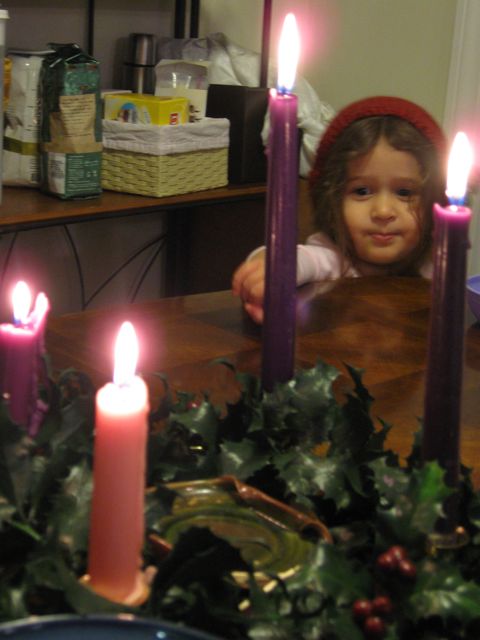
A simple, traditional devotion to aid your family’s liturgical focus is the Advent wreath. Place the blessed wreath at the center of your dinner table. After the family has gathered for the meal, turn off ALL the lights. Before the meal blessing, light the candles, one each for that particular week of Advent. The lighting should be accompanied by prayers, Advent hymns, or readings (made more challenging by the dark, of course), customized by your family’s preferences.

From our faith, we know that we live in a world of darkness and Christ is our only light [Jn 1:3-5]. But our eyes adjust to the darkness, and we can fail to recognize our need for the Uncreated Light. This nightly devotion provides us a perspective on reality. The burning candles become for us, “…a symbol of the prophetic light gradually illuminating the long night prior to the rising of the Sun of justice.” [Directory on Popular Piety, 98]. The subdued light draws the family together and reminds them of Whom is at their center, and that they too are refugees until the day they behold the Eternal Light, gathered with their true family for a feast beyond imagination. After four weeks, even children will anticipate the Infant Jesus more than Santa Claus.

Whether He’s descending the clouds, placed in a manger, or lifted by the hands of a priest, you and your family will welcome the Divine Guest in your heart, and pray with grateful longing, “Come, Lord Jesus!”

For resources on this and other family Advent devotions, visit our Gift Center and view the Advent Workshop at www.catholicculture.org.

Tuesday, May 12, 2009

Idle Hands


And the book of Isaias the prophet was delivered unto him. And as he unfolded the book, he found the place where it was written: The Spirit of the Lord is upon me. Wherefore he hath anointed me to preach the gospel to the poor, he hath sent me to heal the contrite of heart, to preach deliverance to the captives, and sight to the blind, to set at liberty them that are bruised, to preach the acceptable year of the Lord, and the day of reward. And when he had folded the book, he restored it to the minister, and sat down. And the eyes of all in the synagogue were fixed on him. – Luke 4:17-20

In the above scripture, our Blessed Lord put two scriptures together from Isaiah for his listeners in the Nazarene synagogue.  I’m going to try something remotely similar by putting together two recent blog posts.  WARNING – Do not try this at home.  Only a true mytagogue is qualified for such advanced techniques.

Recently, Adoro provided a witness to the problem with the accepted view of evangelizing the new generation of young adults. 

  [T]hey (we!)  are seeking God. And if they enter a parish and find the theology of the parish to be wishy-washy, they leave. If they find disunity, they leave. If they find outreach without sincerity and REAL understanding...they walk.  They realize their lives are worth far more than a ten-cent smile and a frivolous handshake.  They don't want their singlehood to become one of slave labor to the Church, their singlehood a memory of years spent in weird pigeonholed isolation at a parish that doesn't know what to do with them other than to plug them into various volunteer holes that need warm bodies to fill them.   

Young adults want to get involved, yes. Absolutely. But not without a deeper meaning. Not without God. For their primary search, even if they can't explain it, is God. They are seeking happiness. They are seeking Our Lord, and they don't know where YOU have placed Him.

How true!  All too often, as we look to build our parish communities, we end up chasing a somewhat secular (faithless) model for building an organization.  We can’t reach them unless we get them through the door.  We can’t keep them unless they return.  They won’t return unless our community appeals to them.  They won’t be committed unless we give them something to do.  If we push through all of that, the sacraments will do their thing and our community will become the workers’ paradise that we keep singing about.

While I am knocking this approach, it would be wrong not to admit that there is some secular logic to it, which makes it thoroughly tempting.  The flaws, though, are fatal.  I’m sure its practitioners who pervade today’s Catholic parishes are absolutely sincere in their intention of doing the Lord’s work.  But, to put it bluntly, they are following the ideology of Nimrod, that infamous architect of the Tower of Babel .  They left the Catholic Church, the Bride of Christ, behind.  They deliberately ignore Rome, believing that the Holy Spirit can guide us to come up with something better than what God gave us through the Catholic Church.

There are legends that this self-made community works.  There may even be some real-world examples of it.  Yet everywhere I’ve seen it tried, the results are the same.  Efforts to get people more involved inevitably lead to burdening the people who are already too involved.  The stagnant population of the community tend to remain that way.

The bottom line – parishes are putting STEWARDSHIP ahead of CONVERSION.  In fact, there exists a general assumption that stewardship leads to conversion.  It is self-evident that this is entirely backwards.  Did Mother Teresa become a saint because she fed the hungry and cared for the dying?  Or did she feed the hungry and care for the dying because she became a saint?  According to her, and human reason, it’s the latter.

What keeps us Catholics from getting this right?  It’s pretty simple.  If a parish is addressing the needs of souls, it’s doing what it’s supposed to do.  A people that is deeply in love with our Lord Jesus will build the Kingdom the way He wants it built, and that’s all that matters.  Sorry, Nimrod.

And what can a parish do to accomplish this?  For starters, let everyone drop his or her pride, pastors and lay leaders alike.  Read the exhortations of the pope, the dogmatic documents of the ecumenical councils, and the instructions from the curia.  Then watch our Holy Father in action.  How does he say mass?  What is he focusing on in his addresses?  Then look at your community.  Where is your parish lagging?  What is your parish disregarding?  (hint: if the Bishop allows it, it doesn’t mean it’s good.  If he demands it, well, that’s another matter.)  Then get to work on preparing the parish to receive the sacraments in the manor set forth by our High Priest, through his Bride.  The deviation from the treasures God has given us through the Church is an exercise in pride.  Souls will suffer, despite the pleasant veneer some will claim.  

As our Holy Father wrote in a previous job (my emphasis):

[The obligatory character of the liturgy] is a guarantee, testifying to the fact that something greater is taking place here than can be brought about by any individual community or group of people. It expresses the gift of joy, the gift of participation in the cosmic drama of Christ's Resurrection, by which liturgy stands or falls. Moreover the obligatory character of the essential parts of the liturgy also guarantees the true freedom of the faithful: it makes sure that they are not victims of something fabricated by an individual or a group, that they are sharing in the same liturgy that binds the priest, the bishop and the pope. In the liturgy, we are all given the freedom to appropriate, in our own personal way, the mystery which addresses us.Feast of Faith, p 67

Fidelity to the liturgy, along with the needed catechesis (see the blog’s masthead for details), will properly dispose the faithful to the sacraments they receive.  This will light the fire that most seem to think will come about through happy songs and passing out sacred vessels.

And, speaking of happy songs, let me get back to the promise of joining together two blog posts.  Music is a major problem with liturgy today.  Parishes actively seek what they consider attractive music to please the people in the worship space nave.  This form of superficial evangelization plays right in to the misguided attempt to lure young people that Adoro blogged about.  True to form, this attempt to occupy minds and hearts during “silent” periods not only misses the point, but counters the point in so many ways.  Jeffry Tucker wrote a manifesto of sorts on the sociology of Church music, and in doing so covers why this attempt to entertain the people fails miserably:

In light of this, special demands are placed on Catholic musicians to use music that embraces what unites us and allows Catholic communities to thrive, understanding that anyone who is choosing their religion by social considerations alone is not likely to be interested in the Catholic faith to begin with. If we attempt to jump into the existing rivalrous market of demographic stop-'n'-shop, we are surely going to lose. There is always a body of believers out there who can do this better than we can.

And there is another factor here to consider. To seek to appeal to a certain group, we necessarily alienate other groups. We've all had the experience of car pooling or riding in the car with someone who has the radio tuned to a station we find egregious. So it is when we choose this over that form of secular music for our worship. We cannot and will not agree so long as we are choosing on subjective grounds alone.


This is the great error made variously in the history of the faith, mostly recently in the 1960s and 1970s in the U.S. when Catholics attempted to tailor-make their liturgy to blend in with a slice of time in order to win the hearts of a certain age demographic that temporarily believed its wishes were more important than anything else. To do this ended up creating massive division, and we still face the consequences today.

What do Catholics have as a primary concern that others put lower down the list? It is that most unfashionable idea of universal truth, a body of belief and practice, that transcends politics, community, nation, and even time. That is something so precious and wonderful, so appealing in the long run, that we should never turn away from it but rather embrace it completely. In that same way, sacred music challenges us to leave aside our tastes, to bury our egos, to turn off our iPods and digital subscriptions, to look outside our own group identity, and sing a new sing unto the Lord (the text to the Introit in the 5th Sunday of Easter).
I have found myself more and more attracted to a mass that appreciates sacred music.  What a difference from the busyness of the typical performance-style music provided today at most parishes!  I’ve spent many hours in front of the Blessed Sacrament simply making up for the prayer I missed at mass because the entertainment was so distracting.  As efficacious as it is to be in eucharistic adoration, it is no substitute for the mass, where offerings are always accepted and multiplied.  There’s a noise compulsion that is clearly at odds with the mass, as if active participation means we need to keep people’s attention occupied for fear they might have a prayer encounter of their own.

Recently, while commuting home, I heard a Protestant service on the radio.  It was very evangelical, with a charismatic preacher imploring his flock to spread the gospel.   That was followed by a cover of a praise and worship song (guitar, bass, drums, a lot of “I will do this” and “I will do that”) I’d heard before at mass.  But there was a huge difference when I heard it this time.  The music was a perfect fit!  It belonged in this direct style of worship.  There was no mystery to contemplate.  There was no awe in the Incarnation, Death, and Resurrection of our Lord.  It was simple, it was emotional, and it was motivating.  And with the adrenaline rising through the body, the music was seamless.  Thus, praise and worship music has a place.  That was an epiphany for me.

And what purpose does it serve at the mass?  For that matter, what do the emasculated show tunes, jingles, and hippy songs in our modern “song” books accomplish?  At best, they relieve us as we endure the boredom of our weekly liturgy.  At worst, they dull the encounter with our Lord.  They rob us of the, “… freedom to appropriate, in our own personal way, the mystery which addresses us.”  They create noise which deflects our minds and hearts from the fullness of meeting the one whose death makes eternal happiness possible.

It basically changes the mass into a sing-a-long communion service.  As one wise blogger put it, it’s like preparing a prime rib eye steak with a blender.

The result?  Deep conversion is much more difficult as people miss the opportunity to have the fullness of grace which was offered to them.  This is no small matter.  This is a self-inflicted cap on spiritual growth, not to mention a source of theological confusion.

To sum up this entire post, busyness is not the answer to call of the New Evangelization.  Jesus is the answer.  That hasn’t changed in 2000 years.  If someone thinks he has a better idea than the Catholic Church, you know, the one guided by the Holy Spirit, then that someone has his own need of a deeper conversion.  We can’t offer anyone, young or old, something that we don’t have.  Yes, we do have sacraments.  But our vanity can, and does, diminish the work of those sacraments on our lives.  When we truly make the effort to surrender ourselves to His authority and assist at mass to our fullest capacity, no ministry scheme and no liturgical customizations would compare to the attraction we would possess. 

Just to be clear, I am all in favor of innovation and ideas.  But they must first be checked against the directions and advice of Church authority.  All Catholics of good faith want the same thing.  We just need to remember, Nimrod isn’t going to get us there.

Friday, May 1, 2009

The Sky is Falling!!!

This unresting anxiety is the greatest evil which can happen to the soul, sin only excepted. Just as internal commotions and seditions ruin a commonwealth, and make it incapable of resisting its foreign enemies, so if our heart be disturbed and anxious, it loses power to retain such graces as it has, as well as strength to resist the temptations of the Evil One, who is all the more ready to fish (according to an old proverb) in troubled waters.

Anxiety arises from an unregulated desire to be delivered from any pressing evil, or to obtain some hoped-for good. Nevertheless nothing tends so greatly to enchance the one or retard the other as over-eagerness and anxiety.  - St Francis de Sales, Doctor of the Church, Introduction to a Devote Life, Part IV

Light blogging this week.  Well, make that no blogging until now.  Why?  I have to admit that my attitude this week would have been something very wrong to share.  Anxiety has been hard at work on me.  Work has been about as stressful as I can remember.  And the news lately?  I know it can get worse, but this steady drip of death news is sucking the atmosphere dry of hope.

Let’s see, where to begin?  Everything Obama has been bad news.  Thanks to the chance discovery of uncounted ballots in Minnesota (and those chance discoveries always seem to favor the party of death) and the betrayal of a pro-death Republican in Pennsylvania, the president now has the rest of this congress to alter the fabric of America for generations.  And not just our country.  He also wants to export modern American family values to countries that just aren’t aborting their kids fast enough.  Kathleen Sebelius gets in without a wimper thanks to a potential swine flu epidemic.  And now we have a vacancy on the Supreme Court that will be filled by someone even more radical than Obama, not that Justice Souter was any picnic (thanks a lot HW). 

And what’s to turn the tide?  Obama is in the oval office thanks to a growing electorate of the unmarried.  In 2007, 40% of the births in the United States were illegitimate.  Courts are dictating gay marriage, and no one revolts?  This nation has forgotten that the primary purpose of marriage is for the procreation, support, and education of children.  Now marriage is all about self.  So even though the people still instinctively know something is wrong with gay marriage, they can’t argue why without sounding like a bigot.  In two generations, who will be left to explain the purpose of marriage?  Two generations ago, people instinctively knew abortion was wrong.  Four generations ago, people instinctively knew contraception was wrong.  Slowly, sometimes not so slowly, this Culture of Death is claiming our country, a nation that was once portrayed as that “shining city on the hill.”

What’s to turn the tide?  The institutions that saturate our secular culture and influence minds and behaviors are all on the side of this brave, new America.  Entertainment media, news media, corporations, education at all levels – how is one to avoid the groupthink that sex, materialism, and uber self-esteem is the key to happiness?

So I think you get the gist of my anxiety this week.  Bleak prospects at work, bleak prospects for the future of this country (not to mention all the other countries unfortunate enough to follow our lead) and, not mentioned previously, an inordinate number of friends, family and co-workers are going through tough times with employment, sickness, and other tragic circumstances.  Anxiety.  That doesn’t make for an interesting blog post.  Nor a beneficial one.

The Blessed Mother’s Immaculate Heart will prevail.  I know that, with all my heart I know that.  Christ is the victor, and I’m on His side most of the time.  But it is such a challenge to see the decline of goodness in our time and have faith that God will bring about a greater good.  My faith is weak, therefore, I fear.

But the Lord’s mercy is never exhausted, even for those of weak faith.  Today, I have a reprieve.  I failed to pray for it.  In fact, my prayer life slipped mightily during the last week.  Nevertheless, He’s granted a reprieve, and it came though my marriage and the fruit of that marriage.  It came from a child.

I usually say a rosary or chaplet in my car or listen to talk radio on the way home.  I really didn’t feel like praying today (**Alert – I am aware that this is the best time to pray.  Thanks for thinking that anyway**), nor did I want to increase my anxiety by listing to other people complain about what’s going on.  That might alert me to something I didn’t know, and ignorance is preferable in my situation.

I’m weak, so I turned to a source designed for people in my state.  Pop music.  While commuting home from work, to take my mind off the misery of this week, I turned to the music that has made a considerable contribution to the Culture of Death.  To my credit, I dialed away from most of the songs that were too ME ME ME ME ME focused, but a few of them slipped through, like Jesse’s Girl, and Tonight and the Rest of MY Life (I only know the chorus to that song, and listening to the rest, I got the impression that Nina is signing about being a demon.  How’s that for the soul!).  I got to sing along to one of the great sap songs in history, “Honey you!  Are my shining star.  Don't you go away.”  (Don’t worry, that song ain’t going away from any of the heads of you blessed readers.  He he.)  You just have to sway along with that one.  And I got to chill to a Counting Crows song I’d never hear before, but yet I had, if you know what I mean.

And then I had to gasp as I’m sort of singing along to Man on the Moon (“sort of”, meaning my ears cannot discern what Michael Stipe is singing most of the time) and discovered, for the first time, that the song takes silly cheap-shots at organized religion, modeled no doubt by the Catholic Church.

Well, at least it ended on a high note.  A song about anxiety came on the radio.  It’s a song called Overkill, one I used to sing along to in my adolescent years.  This was a version I’d never heard before.  This was Collin Hay solo, just him and his guitar.  Very nice, and very apropos for the mood.  I sat in the driveway until it ended.

Then I entered the house singing.  Don’t worry, my family is used to it.  “Day after day, it reappears.  Night after night, my heartbeat shows the fear.  Ghosts appear and fade away.”  My daughter, bless her, hugged me as I walked in, and listened to me sing as I made my way to the kitchen toward my wife. 

“Daddy, what song is that you're singing?”

“It’s an old song called Overkill.  It’s by a group called Men At Work.”

“Are we going to sing that at Mass?”

My wife and I just about died laughing.  Anxiety gone!  And it hasn’t returned.  Thank you Lord! You truly stoop to conquer. 

(For those of you who don’t get the irony of a five-year old asking if we will be singing a pop song called Overkill at the mass, you obviously aren’t on the All Are Welcome-Gather Us In-City of God-Canticle of the Sun-We Are Called five-week cycle.  You didn’t get it, but that’s okay, because you already have so much)

In your mercy keep us free from sin and protect us from all anxiety as we wait in joyful hope for the coming of our Savior, Jesus Christ. – Roman Missal

Wednesday, April 8, 2009

Why the Truth is so Important

In John 14:6-7, we read:
Jesus said to him, "I am the way and the truth and the life. No one comes to the Father except through me. If you know me, then you will also know my Father. From now on you do know him and have seen him."
The apostle Thomas just asked Jesus to show him the way to heaven. Jesus then says that he "is" the way. The way to heaven is through Jesus.

But that is not all Jesus said. Jesus also said that he "is" the truth, that he "is" the life. If Thomas is just asking about "the way", why doesn't Jesus just say that he "is" the way and leave it at that? Its because to know Jesus we must know the truth also, and we must strive to live the life like Jesus led.

I want to focus here on Jesus' saying that he is the truth. From the very earliest days of the Christian era, we have heard echoes of Pilate's question, "What is Truth?" He stood and looked Truth in the face and asked what is truth. The irony. Our current Christian culture today seems to also deny that absolute truth can be known, as if truth is only the summation of public opinion, or some relativistic notion that anyone can define what their own truth is.

There is an absolute truth, and as in the day when Jesus promised to send the Holy Spirit to lead his Church into all truth, we as Catholics, members of the Church that Jesus founded upon Peter, the Rock, are the fortunate recipients of an eternal promise that will provide us with the only source of eternal truth there is: God himself.

If we consider this fact, we must consider the ramifications: there is only one way to heaven, and that is Jesus. Jesus is the Truth. So without the Truth, there is no way to heaven. If one were to not believe in the truth, one is, in essence, stating that they do not believe in Jesus. And since the Church is the body of Christ in a mystical way, if you don't believe everything the Catholic Church teaches, you don't believe in the truth revealed by Christ, and by extension, put your own salvation on the line.

It takes a measure of humility to submit to everything the Church teaches, but not only is it extremely important, it creates a simple sense of joy. I know this from my own experience, because I can humbly accept the fullness of the Church teaching, I don't have to live my life trying to prove that I am smarter than the brilliant minds who came before me but rather my life upon the rock of truth that is Christ and the revelation of the Holy Spirit to his Church on Earth.

Turn a careful ear to the readings during this Triduum and to our shepherds when they deliever the homilies intended to speak directly to you, and have a blessed, fulfilling, freeing Holy Week.